
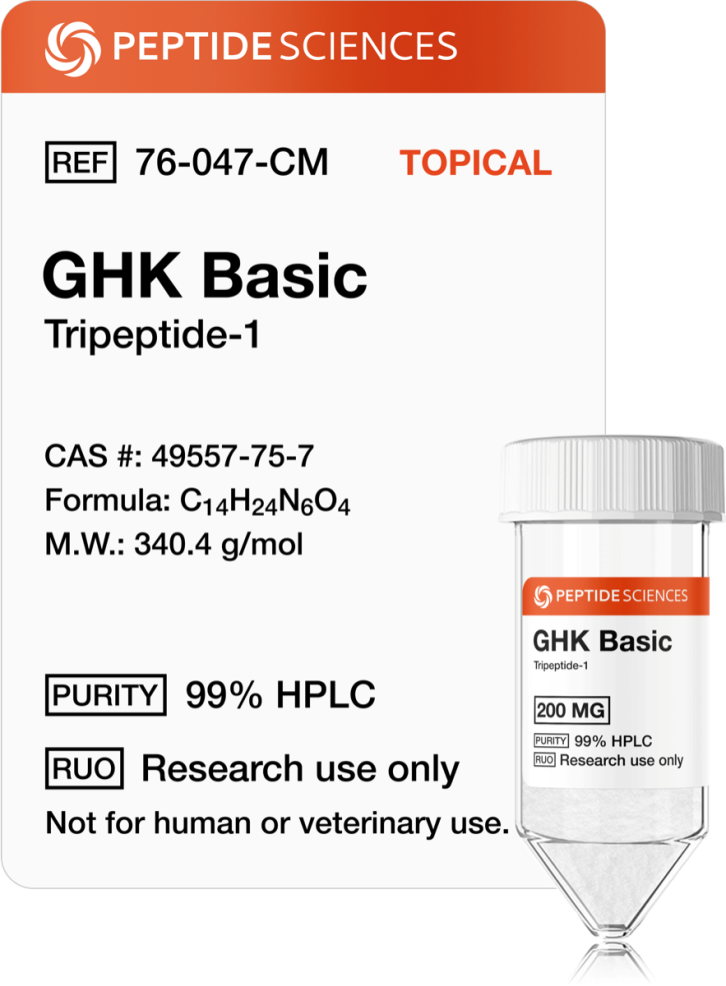
GHK Basic 200mg (Tripeptide-1) (Topical)

$170.00
GHK Basic (Tripeptide-1) is a research peptide consisting of the sequence Gly-His-Lys, a naturally occurring fragment studied for its role in extracellular matrix regulation and antioxidant defense. It influences fibroblast activation, collagen gene expression, and metalloprotein regulation under controlled laboratory conditions. GHK Basic is used as a model for studying peptide-mediated cellular regeneration and redox homeostasis.
For research use only. Not for human consumption.
References:
Pickart L et al., Biochim Biophys Acta, 2015 1850(8):1863–1885
Maquart FX et al., FEBS Lett, 1988 238(2):343–346
Siméon A et al., J Invest Dermatol, 2000 115(6):961–968
🔥 Exclusive Crypto Offer
Get an INSTANT 15% DISCOUNT when you pay with Bitcoin, Ethereum, Dogecoin, Bitcoin Cash, XRP, Solana, or USDT.
⚡ Don't have crypto? Buy it here in 5 minutes with easy guidance.
GHK Basic 200mg (Tripeptide-1) (Topical) – Buy High-Quality GHK Basic 200mg (Tripeptide-1) (Topical) Online
Looking to buy GHK Basic 200mg (Tripeptide-1) (Topical) for your research laboratory? You have come to the right place.
We currently have GHK Basic 200mg (Tripeptide-1) (Topical) for sale and it is in stock and ready for immediate shipping.
Our GHK Basic 200mg (Tripeptide-1) (Topical) is of the highest purity, making it the best GHK Basic 200mg (Tripeptide-1) (Topical) online for scientific studies.
Product Overview
GHK Basic 200mg (Tripeptide-1) (Topical) is a premium research compound widely utilized in various scientific studies.
Researchers seeking to buy GHK Basic 200mg (Tripeptide-1) (Topical) online often prioritize purity and consistency.
This compound has been studied extensively for its unique biochemical properties and its role in cellular pathways.
Overview: GHK Peptide (Glycyl-Histidyl-Lysine)
GHK is a tripeptide with the amino acid sequence glycyl-histidyl-lysine. In preclinical research, GHK is used as a tool compound to evaluate peptide-driven modulation of cellular stress-response programs, extracellular matrix (ECM)-associated transcriptional networks, and metal-ion (Cu) complexation effects. GHK is frequently studied both as the free tripeptide and as a copper complex (GHK-Cu) to compare how transition-metal coordination influences physicochemical behavior and downstream signaling readouts in cellular and in vivo model systems.
Biochemical Characteristics
Identity: GHK (Glycyl-Histidyl-Lysine), tripeptide
Complexation: Commonly evaluated as apo-GHK and as a Cu(II) coordination complex (GHK-Cu) in mechanistic studies
The histidine and terminal amine functionalities in GHK can coordinate metal ions, and copper complexation is used experimentally to probe how redox-active cofactors and peptide coordination chemistry impact protein-binding interactions, gene-expression signatures, and cellular oxidative-stress handling under controlled laboratory conditions.
Research Applications
-
Transcriptomic profiling: Assessment of GHK-associated gene-expression changes across stress, proteostasis, inflammatory, and ECM-related pathways in cultured cells and preclinical models [1–4].
-
Peptide–metal coordination studies: Comparative evaluation of apo-GHK vs GHK-Cu to examine how Cu(II) coordination alters peptide stability, binding behavior, and redox-associated pathway readouts [2].
-
Proteostasis / UPS research: Use in studies examining ubiquitin–proteasome system (UPS) gene programs and protein quality-control signaling [2,4].
-
ECM & remodeling models: Investigation of ECM transcriptional markers, matrix-associated proteins, and remodeling-associated signaling networks (including TGF superfamily-linked gene programs) in cell and animal models [1–3].
-
Inflammation-related readouts: Evaluation of cytokine-linked mechanisms (e.g., IL-6-associated programs) and downstream acute-phase gene networks in relevant cellular systems [1,4].
-
Insulin/IGF-like signaling exploration: Use as a mechanistic probe for insulin/IGF-like pathway gene sets in preclinical gene-expression datasets [2,4].
Pathway / Mechanistic Context
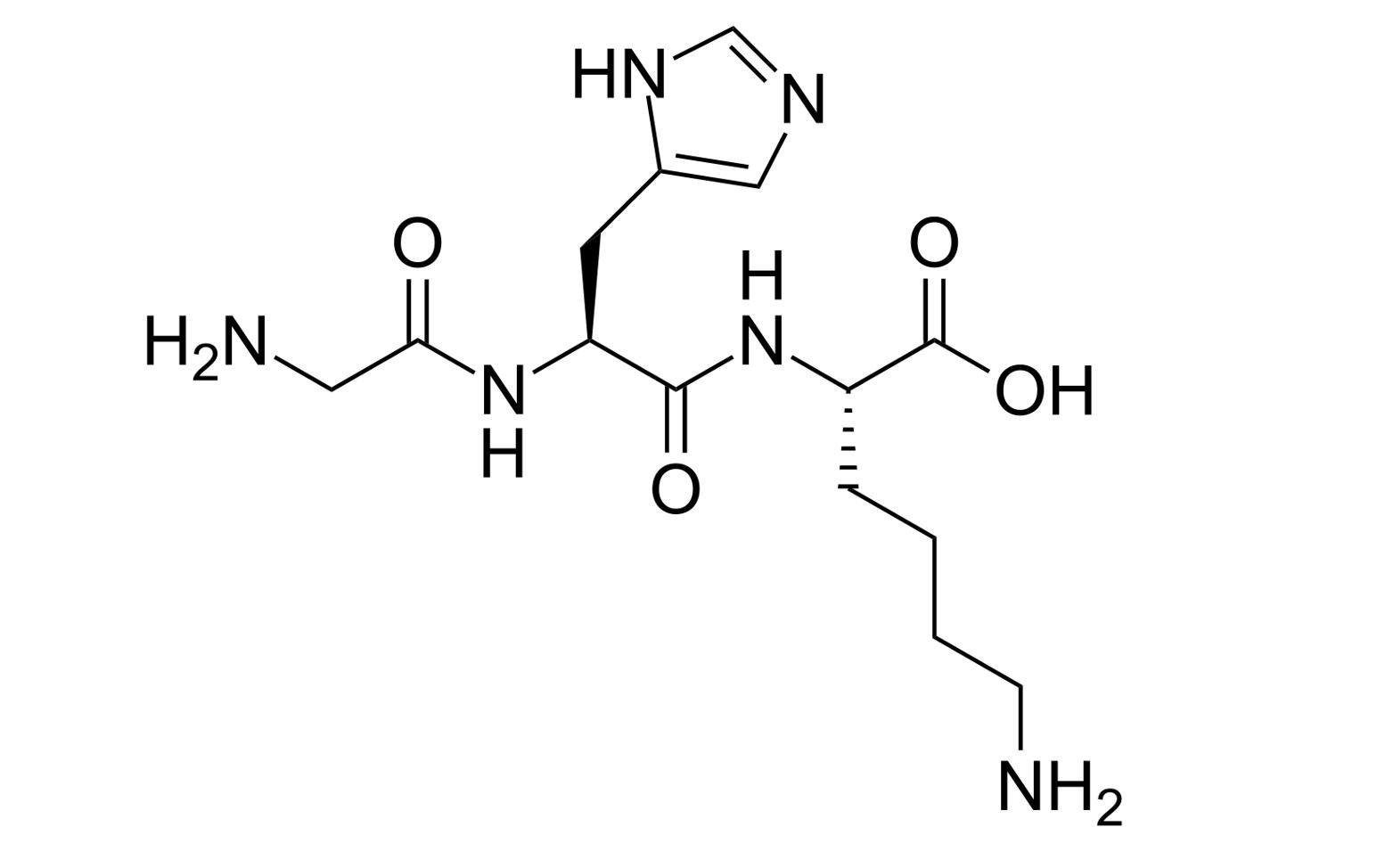
GHK vs GHK-Cu (conceptual distinction): In experimental designs, GHK is evaluated either as the free tripeptide or as a copper coordination complex (GHK-Cu). Copper coordination can influence peptide conformation, charge distribution, and redox behavior, which may shift pathway readouts in assays focused on oxidative-stress handling, transcriptional regulation, and matrix-associated signaling [2].
Copper as a redox-active cofactor: Copper is a transition metal used by numerous enzymes that rely on Cu(I)/Cu(II) interconversion to support electron-transfer chemistry. In biological systems, copper-dependent enzymes are involved in processes such as cellular respiration, antioxidant defense, and connective-tissue crosslinking. In RUO contexts, copper–peptide coordination is used to study how metal availability and ligand binding can affect pathway-level signaling and gene expression under controlled conditions [2].
ECM-linked peptide fragments: Short peptide motifs associated with matrix proteins (including sequences present in collagen-associated proteins such as SPARC) are frequently used as research tools to examine remodeling-associated programs and cell–matrix signaling. GHK is discussed in the literature as a motif relevant to matrix-associated turnover and remodeling models [1,3].
Preclinical Research Summary
1. Fibrinogen / IL-6-Linked Gene Programs
Preclinical gene-expression analyses summarized in the referenced literature describe GHK-associated modulation of inflammatory and acute-phase signaling, including IL-6-linked programs and fibrinogen-chain gene sets (e.g., FGB). These observations are typically reported from in vitro cellular systems and transcriptomic datasets used to infer pathway-level effects [1,4].
2. Ubiquitin/Proteasome System (UPS)
Reported transcriptional datasets include enrichment of ubiquitin–proteasome system (UPS) gene programs, a pathway class central to protein quality control and removal of damaged proteins. RUO studies use these readouts to map proteostasis-linked responses in cultured cells under defined experimental perturbations [2,4].
3. DNA Repair Gene Sets
Published analyses describe associations between GHK exposure and altered expression of DNA repair-related genes in in vitro models. In an RUO setting, these data are used as mechanistic background for selecting endpoints and validating pathway enrichment rather than for any intended-use interpretation [2,4].
4. Oxidative-Stress / Antioxidant Gene Programs
Gene-expression summaries in the cited references report changes in antioxidant and oxidative-stress-associated gene panels following GHK or GHK-Cu exposure in experimental systems. Such datasets are frequently used to study redox-response signaling and copper-dependent effects in cell culture [1,2].
5. Insulin / IGF-Like Signaling Signatures
Transcriptomic analyses discussed in the cited literature include modulation of insulin/IGF-like pathway gene sets. In preclinical research, these signatures are typically evaluated as part of broader systems-biology analyses to understand pathway coupling between metabolism-linked networks and stress-response programs [2,4].
6. TGF Superfamily-Associated Remodeling Programs
The referenced publications discuss GHK-associated gene programs that intersect with TGF superfamily signaling, a pathway group that regulates cell differentiation, ECM remodeling, and tissue-architecture-related transcriptional responses in many model systems. RUO studies may use these observations to guide mechanistic hypotheses and downstream validation experiments [1,3,4].
7. Cancer-Related Gene-Set Reversal Analyses
The cited literature includes discussions of gene-expression signature analyses in which compounds (including GHK in specified in vitro conditions) are evaluated for their ability to reverse predefined disease-associated transcriptional patterns. In an RUO context, these approaches are used as computational and experimental tools for pathway mapping and hypothesis generation in oncology-related model systems, without implying any intended use [2,4].
Conclusion
Across the cited publications, GHK and GHK-Cu are described primarily as research tools for probing multi-pathway gene expression, including ECM remodeling, proteostasis (UPS), oxidative-stress responses, and growth-factor/cytokine-linked signaling. These observations derive from preclinical datasets (cell culture systems, transcriptomic analyses, and model-based investigations) and are used to inform experimental design, endpoint selection, and mechanistic interpretation [1–4].
Any pharmacokinetic, tolerability, or administration statements from nonclinical reports should be interpreted strictly as preclinical background for experimental planning and are not indicative of suitability for any intended-use context.
Form & Analytical Testing
GHK is supplied as a purified research reagent intended for laboratory experimentation. Product identity and purity are typically confirmed using analytical techniques such as high-performance liquid chromatography (HPLC) and mass spectrometry (MS). Standard peptide handling and storage practices should be followed in research environments.
Referenced Citations
- Pickart, Loren & Vasquez-Soltero, Jessica & Margolina, Anna. (2015). GHK Peptide as a Natural Modulator of Multiple Cellular Pathways in Skin Regeneration. BioMed Research International. Article ID 648108. 10.1155/2015/648108.
- Pickart, L., & Margolina, A. (2018). Regenerative and Protective Actions of the GHK-Cu Peptide in the Light of the New Gene Data. International journal of molecular sciences, 19(7), 1987. https://doi.org/10.3390/ijms19071987
- Pickart L. The human tri-peptide GHK and tissue remodeling. J Biomater Sci Polym Ed. 2008;19(8):969-88. doi: 10.1163/156856208784909435. PMID: 18644225.
- Loren Pickart, Jessica Michelle Vasquez-Soltero, Anna Margolina, “GHK and DNA: Resetting the Human Genome to Health”, BioMed Research International, vol. 2014, Article ID 151479, 10 pages, 2014. https://doi.org/10.1155/2014/151479
ALL ARTICLES AND PRODUCT INFORMATION PROVIDED ON THIS WEBSITE ARE FOR INFORMATONAL AND EDUCATIONAL PURPOSES ONLY.
RUO Disclaimer
The products offered on this website are furnished for in-vitro studies only. In-vitro studies (Latin: in glass) are performed outside of the body. These products are not medicines or drugs and have not been approved by the FDA to prevent, treat or cure any medical condition, ailment or disease. Bodily introduction of any kind into humans or animals is strictly forbidden by law.
For Laboratory Research Only. Not for human use, medical use, diagnostic use, or veterinary use.
Why Choose Our GHK Basic 200mg (Tripeptide-1) (Topical)?
When you are looking for GHK Basic 200mg (Tripeptide-1) (Topical) for sale, quality is paramount.
Our products undergo rigorous testing to ensure they meet the strict requirements of laboratory environments.
By choosing to buy GHK Basic 200mg (Tripeptide-1) (Topical) from our store, you are guaranteed a product that is:
- High Purity (Tested for 99%+)
- Fast Shipping – Always in stock
- Secure Packaging for Research Integrity
- Competitive Pricing for Bulk Orders
Specifications & Technical Data
| Feature | Specification |
|---|---|
| Product Name | GHK Basic 200mg (Tripeptide-1) (Topical) |
| SKU | 48 |
| Purity | >99% |
| Form | Research Grade Compound |
| Availability | In Stock / For Sale |
Scientific Research & Clinical Applications
The research surrounding GHK Basic 200mg (Tripeptide-1) (Topical) is vast. Scientists explore its potential in various metabolic and physiological models.
For more detailed scientific data, you can visit PubMed
to review the latest peer-reviewed literature regarding this compound.
Frequently Asked Questions
Where can I buy GHK Basic 200mg (Tripeptide-1) (Topical)?
You can buy GHK Basic 200mg (Tripeptide-1) (Topical) directly from our website. We provide a secure checkout and fast shipping to ensure your research stays on track.
Is GHK Basic 200mg (Tripeptide-1) (Topical) in stock?
Yes, we currently have GHK Basic 200mg (Tripeptide-1) (Topical) in stock. Orders are typically processed within 24 hours to ensure rapid delivery to your laboratory.
Related Research Products
If you are interested in GHK Basic 200mg (Tripeptide-1) (Topical), you may also want to explore these related products currently in stock:
Disclaimer: All products listed are for research purposes only. Not for human consumption.
Related products

All Peptides

All Peptides

All Peptides

All Peptides

All Peptides
All Peptides

All Peptides
All Peptides