
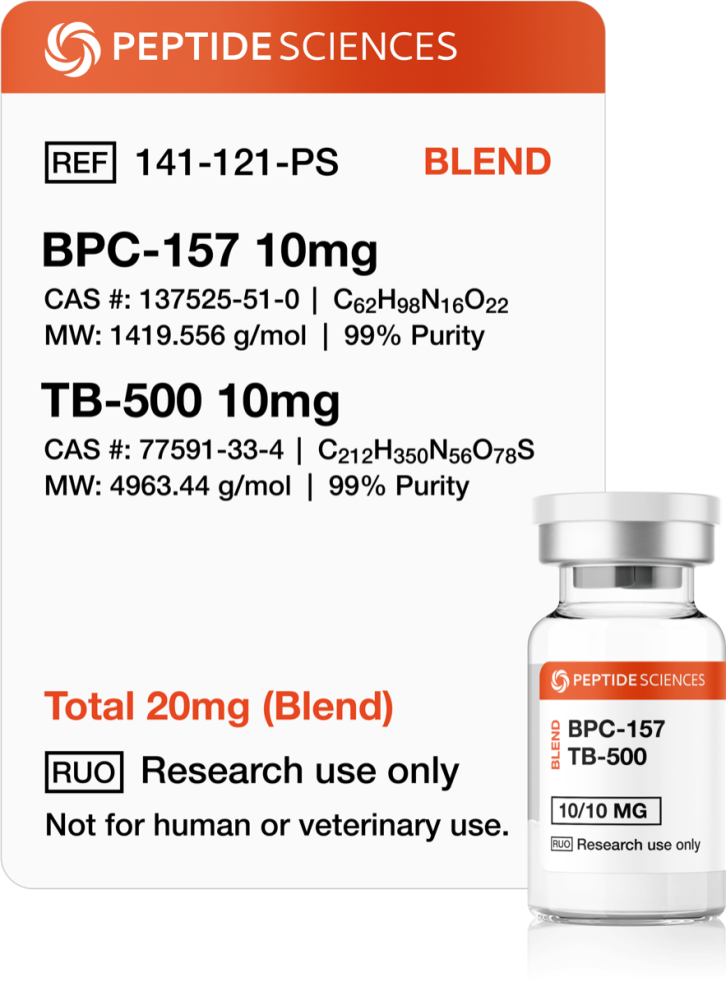
BPC-157, TB-500 20mg (Blend)
$200.00
The BPC-157 and TB-500 blend combines two well-characterized research peptides studied for their roles in cellular repair, angiogenesis, and tissue remodeling. BPC-157 is a 15 amino acid gastric peptide fragment that modulates nitric oxide pathways and growth factor signaling. TB-500, a segment of Thymosin Beta-4, regulates actin polymerization and promotes cytoskeletal organization. Together, these peptides are used in preclinical research investigating regenerative biology, wound modulation, and peptide-mediated cellular recovery mechanisms.
For research use only. Not for human consumption.
References:
Sikiric P et al., Curr Pharm Des, 2018 24(18):2002–2030
Goldstein AL et al., Ann NY Acad Sci, 2007 1112:148–154
Malinda KM et al., FASEB J, 1999 13(14):2106–2114
BPC-157, TB-500 20mg (Blend) – Buy High-Quality BPC-157, TB-500 20mg (Blend) Online
Looking to buy BPC-157, TB-500 20mg (Blend) for your research laboratory? You have come to the right place.
We currently have BPC-157, TB-500 20mg (Blend) for sale and it is in stock and ready for immediate shipping.
Our BPC-157, TB-500 20mg (Blend) is of the highest purity, making it the best BPC-157, TB-500 20mg (Blend) online for scientific studies.
Product Overview
BPC-157, TB-500 20mg (Blend) is a premium research compound widely utilized in various scientific studies.
Researchers seeking to buy BPC-157, TB-500 20mg (Blend) online often prioritize purity and consistency.
This compound has been studied extensively for its unique biochemical properties and its role in cellular pathways.
BPC-157, TB-500 Blend: Overview
Research reveals that BPC-157 and TB-500 may have complementary actions in wound repair biology. Although both peptides have been studied in the context of healing and inflammation control, they appear to influence tissue repair through different biochemical “entry points.” This creates a plausible rationale for synergy when the two are evaluated together in controlled laboratory models.
From a research-design standpoint, the key hypothesis is not that the peptides duplicate each other’s effects, but that they may support different rate-limiting steps in repair—such as cellular recruitment to the injury site, fibroblast function, extracellular matrix organization, angiogenesis, and the transition from inflammatory signaling to remodeling. The sections below organize the mechanistic rationale into a structured framework to support experimental planning and outcome measurement.
BPC-157, TB-500 Blend: Biochemical Characteristics
BPC-157 is a pentadecapeptide investigated in multiple tissue injury models. In published tendon-focused work, BPC-157 has been associated with cellular survival and migration processes relevant to healing, including changes that support fibroblast activity and outgrowth in damaged tissue[1].
TB-500 is studied as a thymosin beta-4–related peptide in the context of tissue repair, inflammation, and fibrosis biology. Thymosin beta-4 is well known for its relationship to actin dynamics and cell movement, and the broader literature describes roles in wound healing and angiogenesis (including hair follicle–related biology in certain models)[5]. In fibrosis-oriented contexts, thymosin beta-4 has also been discussed as a regulator of pathways tied to tissue remodeling[2].
A practical biochemical framing for combined research is: BPC-157 is often discussed in terms of gene-level or signaling-level modulation of repair programs in injured tissues, while TB-500 (as a thymosin beta-4–related peptide) is commonly framed around actin-related cell motility and broader repair signaling. This difference supports a testable synergy concept rather than simple redundancy.
BPC-157, TB-500 Blend: Research Applications
The combined study of BPC-157 and TB-500 is primarily relevant to research questions where cell recruitment, migration, and coordinated remodeling are limiting factors. Example research contexts include:
- Wound repair models requiring fibroblast migration, extracellular matrix deposition, and remodeling
- Tendon/ligament repair models focused on cell survival, outgrowth, and restoration of tissue organization[1]
- Fibrosis and remodeling research where thymosin beta-4–related pathways are of interest[2]
- Angiogenesis-associated repair questions (e.g., vascular support as a rate limiter in tissue regeneration)[5]
Because “synergy” is an outcome claim that must be demonstrated experimentally, this page frames synergy as a hypothesis: if BPC-157 and TB-500 affect different bottlenecks in repair (gene expression vs. cytoskeletal mobilization, for example), combined administration in preclinical designs may produce additive or multiplicative improvements in migration speed, wound closure kinetics, tissue organization, or histologic markers of remodeling—depending on model choice and endpoints.
BPC-157, TB-500 Blend: Pathway / Mechanistic Context
Successful wound healing depends on fibroblasts (which regulate extracellular matrix production) as well as cells of the immune system. For these cells to perform their functions, they must move to the site of injury. This movement—cell migration—is tightly linked to cytoskeletal remodeling, and especially to the protein actin.
In the tendon-healing literature, BPC-157 is described as promoting repair processes that include effects on cell survival and migration, suggesting that it can support the cellular behaviors required for organized tissue repair[1]. In practical mechanistic terms, this positions BPC-157 as a candidate modulator of the repair “program” that governs whether cells survive, arrive, and remain functional in the injury microenvironment.
TB-500 (in the context of thymosin beta-4 biology) is commonly framed around actin dynamics and the cell’s ability to move, reorient, and participate in repair. The thymosin beta-4 literature includes discussion of roles in wound healing and angiogenesis, and fibrosis-related contexts also emphasize pathway-level regulation connected to remodeling[2], [5].
Combined hypothesis for synergy in migration: If BPC-157 supports the transcriptional/signaling environment that enables migration and survival, while TB-500 supports actin-associated motility and the physical execution of migration, then co-administration may increase both (1) the number of cells that can participate effectively and (2) the speed/efficiency with which they reach the injury site and organize the repair scaffold.
The “big picture” involving growth hormone signaling: One plausible intersection point discussed in the literature is the behavior of fibroblasts in response to growth signals. BPC-157 has been reported to increase expression of growth hormone receptors on tendon fibroblasts in a tendon-focused model[3]. In a mechanistic framing, this can be interpreted as potentially increasing fibroblast responsiveness to endogenous repair cues. In combined designs, TB-500’s relationship to cytoskeletal readiness and migration may influence how effectively fibroblasts utilize extended survival/activation windows. Importantly, this is a research rationale—the net effect must be established in controlled models with defined endpoints.
BPC-157, TB-500 Blend: Preclinical Research Summary
The primary evidence base referenced here consists of: (1) tendon-oriented work linking BPC-157 to outgrowth, survival, and migration processes relevant to repair[1], and (2) thymosin beta-4 literature discussing pathway-level roles in remodeling and fibrosis-related biology[2], as well as angiogenesis and wound healing contexts[5].
From these sources, a reasonable preclinical summary is:
- BPC-157: associated with tissue repair behaviors that include cell survival and migration in tendon-focused models[1].
- Thymosin beta-4/TB-500 context: discussed in relation to fibrosis/remodeling pathways and repair-associated angiogenesis across multiple research domains[2], [5].
- Intersection concept: migration and remodeling biology (actin-driven movement repair-program signaling) provides a mechanistic bridge for combination testing.
Because “synergy” is a higher bar than “overlap,” rigorous evaluation typically requires combination arms vs. single-peptide arms, standardized injury models, and predefined endpoints (migration assays, histology, collagen organization, vascular markers, inflammatory markers, and functional recovery metrics).
BPC-157, TB-500 Blend: Form & Analytical Testing
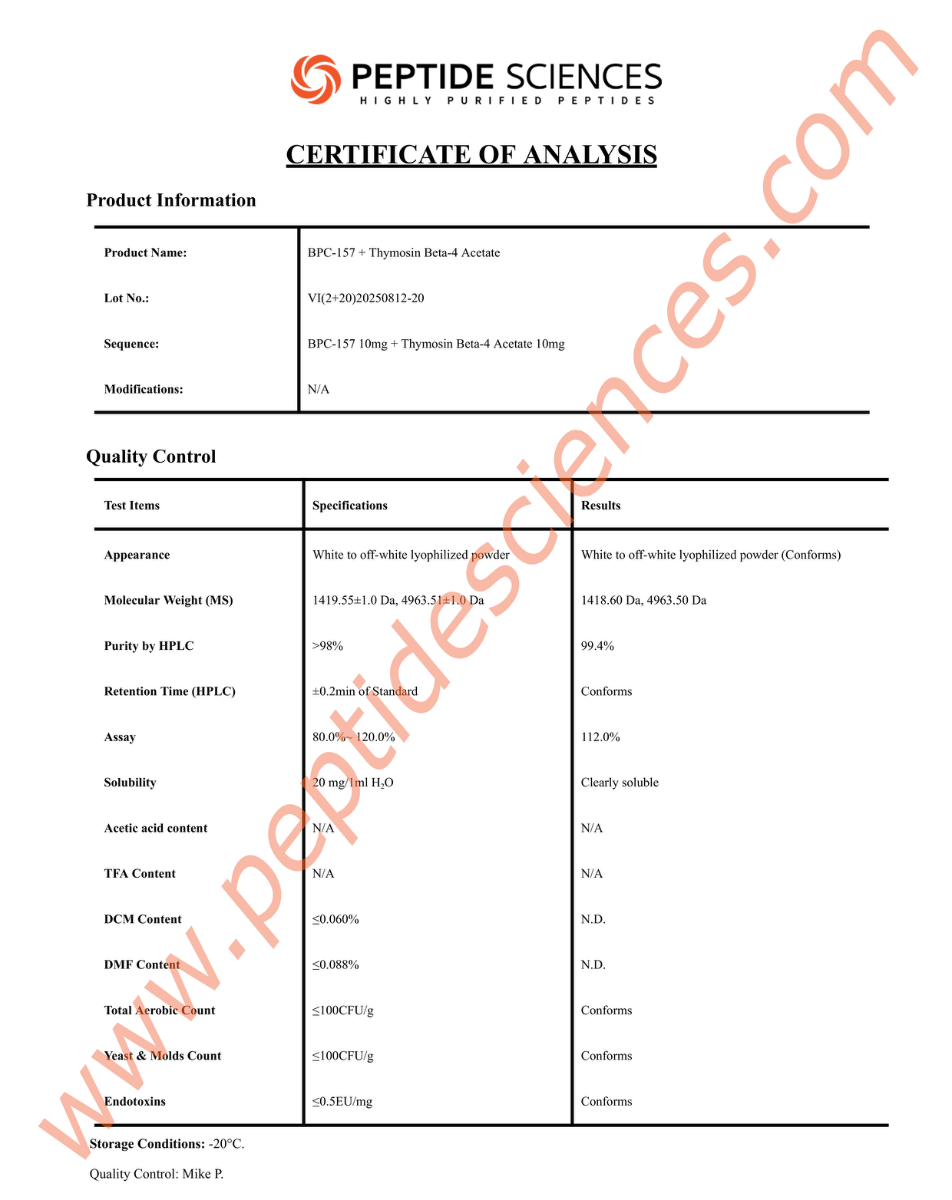
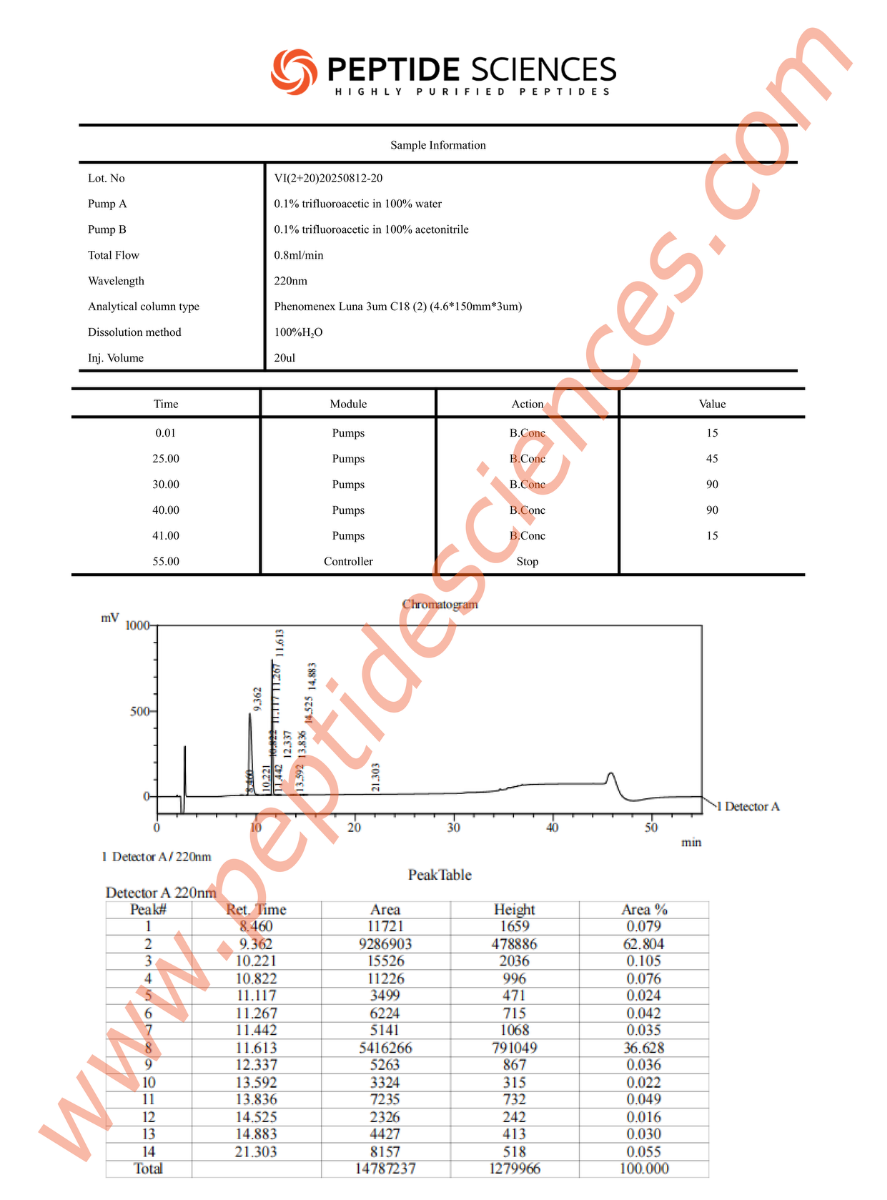
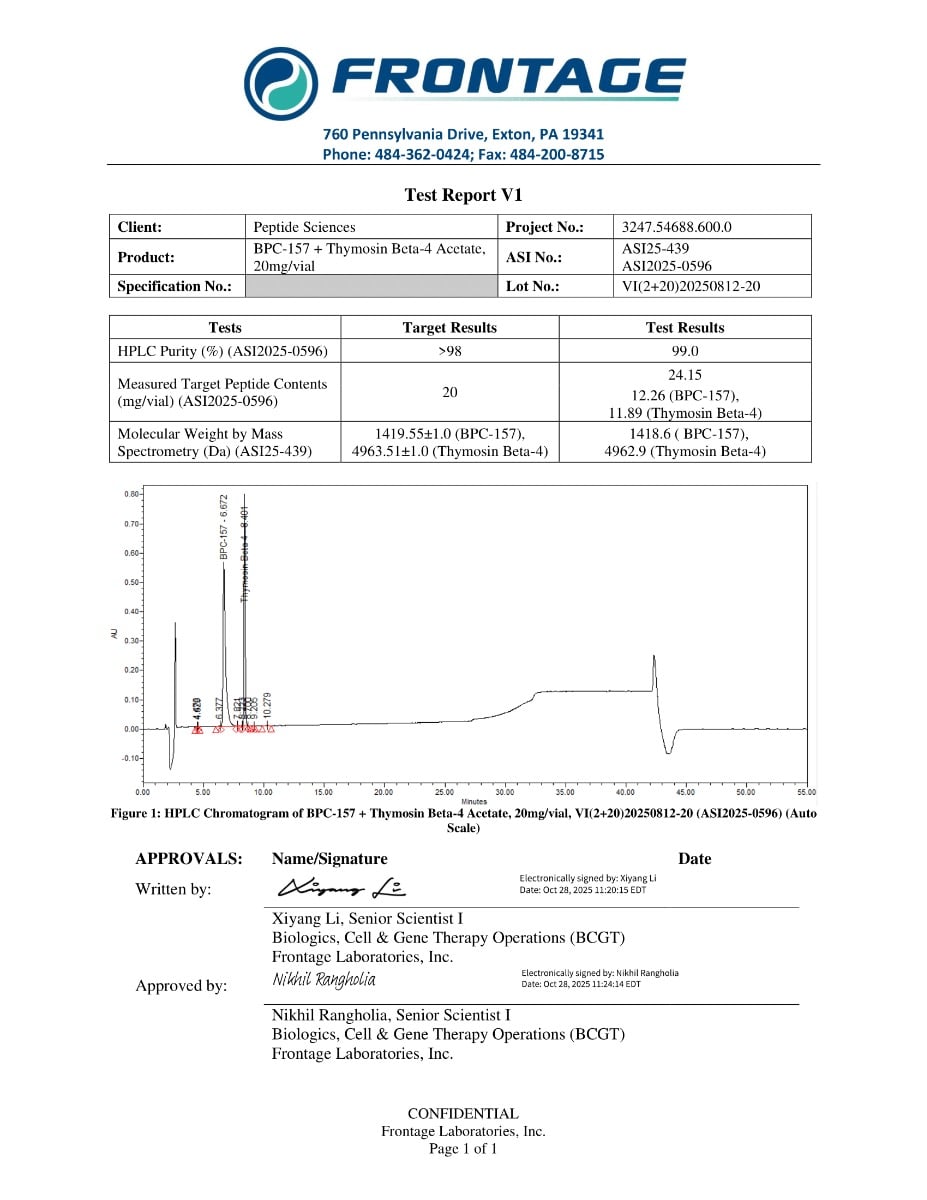
This educational research page discusses mechanistic hypotheses and referenced literature regarding BPC-157 and TB-500. Analytical testing (when applicable to a specific research material or batch) typically focuses on confirming identity and assessing purity using standard laboratory approaches such as chromatography and/or mass spectrometry. Any batch-specific documentation (e.g., COA) should be consulted directly where provided for the material being studied.
About The Author
The above literature was researched, edited and organized by Dr. E. Logan, M.D. Dr. E. Logan holds a doctorate degree from Case Western Reserve University School of Medicine and a B.S. in molecular biology.
Scientific Journal Author
Allan L. Goldstein, MD, Allan L. Goldstein is professor and Catharine B. & William McCormick Chair of the department of Biochemistry and Molecular Biology at The George Washington University School of Medicine and Health Sciences, where he has served since 1978. Thymosins were discovered in the mid 1960’s, when Allan Goldstein from the Laboratory of Abraham White at the Albert Einstein College of Medicine in New York studied the role of the thymus in development of the vertebrate immune system. He is a world-renowned authority on the thymus gland and the workings of the immune system, and co-discoverer of the thymosins. Dr. Goldstein is the author of over 400 scientific articles in professional journals, the inventor on more than 15 U.S. Patents, and the editor of several books in the fields of biochemistry, biomedicine, immunology and neuro-science. He is on the editorial boards of numerous scientific and medical journals and has been a consultant to many re-search organizations in industry and government; co-founder of The Institute for Advanced Studies in Aging and Geriatric Medicine, a non-profit research and educational institute; a member of the Board of Trustees of the Albert Sabin Vaccine Institute; and serves as the Chairman of the Board of RegeneRx Biopharmaceuticals. Dr. Goldstein received his B.S. from Wagner College in 1959 and his M.S. and Ph.D. from Rutgers University in 1964. He served as a faculty member of the Albert Einstein College of Medicine from 1964 to 1972, and moved to the University of Texas Medical Branch in Galveston in 1972 as professor and director of the division of Biochemistry.
Allan L. Goldstein, MD is being referenced as one of the leading scientists involved in the research and development of TB-500 and other Thymosins. In no way is this doctor/scientist endorsing or advocating the purchase, sale, or use of this product for any reason. There is no affiliation or relationship, implied or otherwise, between Peptide Sciences and this doctor. The purpose of citing the doctor is to acknowledge, recognize, and credit the exhaustive research and development efforts conducted by the scientists studying this peptide. Dr. Goldstein is listed in [5] under the referenced citations.
Resources
- C.-H. Chang, W.-C. Tsai, M.-S. Lin, Y.-H. Hsu, and J.-H. S. Pang, “The promoting effect of pentadecapeptide BPC 157 on tendon healing involves tendon outgrowth, cell survival, and cell migration,” J. Appl. Physiol., vol. 110, no. 3, pp. 774–780, Oct. [Physiology.org]
- J. Kim and Y. Jung, “Potential Role of Thymosin Beta 4 in Liver Fibrosis,” Int. J. Mol. Sci., vol. 16, no. 5, pp. 10624–10635, May 2015. [NCBI]
- C.-H. Chang, W.-C. Tsai, Y.-H. Hsu, and J.-H. S. Pang, “Pentadecapeptide BPC 157 enhances the growth hormone receptor expression in tendon fibroblasts,” Mol. Basel Switz., vol. 19, no. 11, pp. 19066–19077, Nov. 2014. [NCBI]
- Song, Ran & Choi, Hyun & Yang, Hyung-In & Yoo, Myung & Park, Yong-Beom & Kim, Kyoung. (2012). Association between serum thymosin β4 levels of rheumatoid arthritis patients and disease activity and response to therapy. Clinical rheumatology. 31. 1253-8. 10.1007/s10067-012-2011-7. [Research Gate]
- Philp, D., et al. “Thymosin β4 Promotes Angiogenesis, Wound Healing, and Hair Follicle Development.” Mechanisms of Ageing and Development, vol. 125, no. 2, Feb. 2004, pp. 113–115, 10.1016/j.mad.2003.11.005. [PubMed]
ALL ARTICLES AND PRODUCT INFORMATION PROVIDED ON THIS WEBSITE ARE FOR INFORMATIONAL AND EDUCATIONAL PURPOSES ONLY.
The products offered on this website are furnished for in-vitro studies only. In-vitro studies (Latin: in glass) are performed outside of the body. These products are not medicines or drugs and have not been approved by the FDA to prevent, treat or cure any medical condition, ailment or disease. Bodily introduction of any kind into humans or animals is strictly forbidden by law.
RUO Disclaimer
For Laboratory Research Only. Not for human use, medical use, diagnostic use, or veterinary use.

Storage Instructions:
All of our products are manufactured using the Lyophilization (Freeze Drying) process, which ensures that our products remain 100% stable for shipping for up to 3-4 months.
Once the peptides are reconstituted (mixed with bacteriostatic water), they must be stored in the fridge to maintain stability. After reconstitution, the peptides will remain stable for up to 30 days.
Lyophilization is a unique dehydration process, also known as cryodesiccation, where the peptides are frozen and then subjected to low pressure. This causes the water in the peptide vial to sublimate directly from solid to gas, leaving behind a stable, crystalline white structure known as lyophilized peptide. The puffy white powder can be stored at room temperature until you’re ready to reconstitute it with bacteriostatic water.
Once peptides have been received, it is imperative that they are kept cold and away from light. If the peptides will be used immediately, or in the next several days, weeks or months, short-term refrigeration under 4C (39F) is generally acceptable. Lyophilized peptides are usually stable at room temperatures for several weeks or more, so if they will be utilized within weeks or months such storage is typically adequate.
However, for longer term storage (several months to years) it is more preferable to store peptides in a freezer at -80C (-112F). When storing peptides for months or even years, freezing is optimal in order to preserve the peptide’s stability.
Why Choose Our BPC-157, TB-500 20mg (Blend)?
When you are looking for BPC-157, TB-500 20mg (Blend) for sale, quality is paramount.
Our products undergo rigorous testing to ensure they meet the strict requirements of laboratory environments.
By choosing to buy BPC-157, TB-500 20mg (Blend) from our store, you are guaranteed a product that is:
- High Purity (Tested for 99%+)
- Fast Shipping – Always in stock
- Secure Packaging for Research Integrity
- Competitive Pricing for Bulk Orders
Specifications & Technical Data
| Feature | Specification |
|---|---|
| Product Name | BPC-157, TB-500 20mg (Blend) |
| SKU | 14 |
| Purity | >99% |
| Form | Research Grade Compound |
| Availability | In Stock / For Sale |
Scientific Research & Clinical Applications
The research surrounding BPC-157, TB-500 20mg (Blend) is vast. Scientists explore its potential in various metabolic and physiological models.
For more detailed scientific data, you can visit PubMed
to review the latest peer-reviewed literature regarding this compound.
Frequently Asked Questions
Where can I buy BPC-157, TB-500 20mg (Blend)?
You can buy BPC-157, TB-500 20mg (Blend) directly from our website. We provide a secure checkout and fast shipping to ensure your research stays on track.
Is BPC-157, TB-500 20mg (Blend) in stock?
Yes, we currently have BPC-157, TB-500 20mg (Blend) in stock. Orders are typically processed within 24 hours to ensure rapid delivery to your laboratory.
Related Research Products
If you are interested in BPC-157, TB-500 20mg (Blend), you may also want to explore these related products currently in stock:
Disclaimer: All products listed are for research purposes only. Not for human consumption.
Related products

All Peptides

All Peptides
All Peptides

All Peptides

All Peptides

All Peptides

All Peptides

All Peptides