
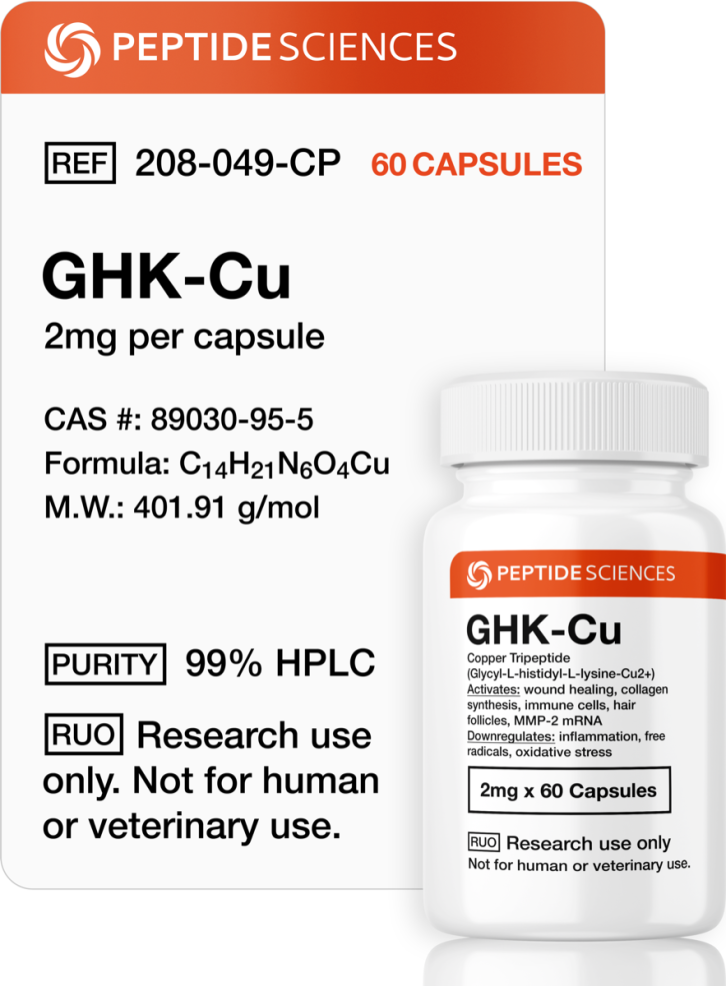
GHK-Cu (2mg x 60 Capsules) (Copper Tripeptide)
$165.00
GHK-Cu is a naturally occurring copper-binding tripeptide (Gly-His-Lys·Cu²⁺) studied for its role in gene expression, extracellular matrix synthesis, and metalloprotein regulation. It forms a high-affinity complex with copper ions that modulates enzymatic catalysis, collagen remodeling, and redox balance in experimental systems. GHK-Cu is widely used in molecular biology and biochemistry research investigating peptide–metal interactions and cellular regenerative mechanisms.
References:
Pickart L et al., BioMed Res Int, 2015
Maquart FX et al., FEBS Lett, 1988;238(2):343–346
Siméon A et al., J Invest Dermatol, 2000;115(6):961–968
These capsules are provided exclusively as inert containers for the dry transport, storage, and handling of laboratory research materials. They are not dosage forms and are not intended for ingestion or administration. They must not be used as drug delivery systems, consumed, or administered in any form. For Research Use Only: Not for use in humans or animals. Not for diagnostic or therapeutic purposes.
GHK-Cu (2mg x 60 Capsules) (Copper Tripeptide) – Buy High-Quality GHK-Cu (2mg x 60 Capsules) (Copper Tripeptide) Online
Looking to buy GHK-Cu (2mg x 60 Capsules) (Copper Tripeptide) for your research laboratory? You have come to the right place.
We currently have GHK-Cu (2mg x 60 Capsules) (Copper Tripeptide) for sale and it is in stock and ready for immediate shipping.
Our GHK-Cu (2mg x 60 Capsules) (Copper Tripeptide) is of the highest purity, making it the best GHK-Cu (2mg x 60 Capsules) (Copper Tripeptide) online for scientific studies.
Product Overview
GHK-Cu (2mg x 60 Capsules) (Copper Tripeptide) is a premium research compound widely utilized in various scientific studies.
Researchers seeking to buy GHK-Cu (2mg x 60 Capsules) (Copper Tripeptide) online often prioritize purity and consistency.
This compound has been studied extensively for its unique biochemical properties and its role in cellular pathways.
Overview
GHK-Cu (copper glycyl-L-histidyl-L-lysine) is a naturally occurring tripeptide–copper(II) coordination complex studied in preclinical research as a regulator of copper bioavailability and copper-dependent signaling. The tripeptide ligand (GHK) chelates Cu2 with high affinity, enabling controlled investigation of copper sequestration, delivery, and redistribution in extracellular and cellular environments. Experimental literature has evaluated GHK-Cu in diverse in vitro systems and in vivo animal models as a probe for pathways associated with metal-ion homeostasis, redox regulation, extracellular matrix turnover, and injury-responsive transcriptional programs.
Across laboratory models, GHK-Cu has been reported to influence processes frequently tracked as preclinical endpoints, including collagen/elastin-associated extracellular matrix synthesis, angiogenesis-related signaling, antioxidant response pathways, immune-cell recruitment, and proteostasis. These observations are interpreted mechanistically as copper-mediated modulation of enzyme activity, transcription factor signaling, and gene-expression networks rather than as outcomes or claims of applied use.
Biochemical Characteristics
Amino Acid Sequence: Gly-His-Lys(Cu2 )
Molecular Formula: C16H28CuN6O6-2
Molecular Weight: 463.98 g/mol
PubChem CID: 156588903
CAS Number: 49557-75-7
Synonyms: copper glycyl-histidyl-lysine, lamin
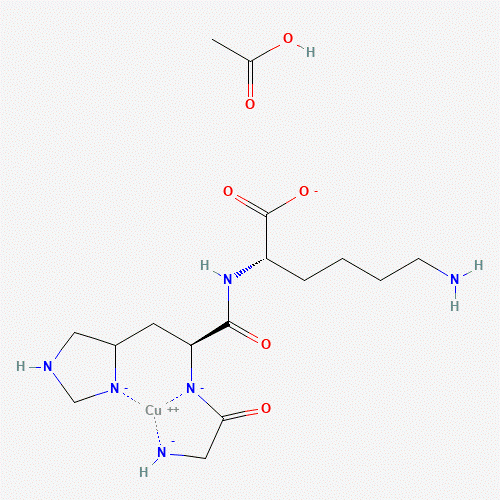
Source: PubChem
GHK coordinates Cu2 through nitrogen- and oxygen-donor atoms contributed by the glycine N-terminus, histidine imidazole, and lysine-associated functional groups, forming a stable yet exchange-capable complex in aqueous systems. This coordination chemistry is leveraged in laboratory research to study copper partitioning between peptide ligands, proteins, and cellular compartments, as well as copper-dependent catalytic and redox processes under defined experimental conditions.
Research Applications
GHK-Cu is used as a research reagent in mechanistic studies of copper homeostasis and copper-sensitive signaling. Typical preclinical applications include cell-based assays examining oxidative stress response (e.g., ROS handling and antioxidant pathway activation), transcriptional profiling of metal-responsive and inflammatory gene networks, and extracellular matrix (ECM) remodeling readouts (e.g., collagen-associated transcript/protein markers, elastin-associated markers, and matrix metalloproteinase regulation) in fibroblast, epithelial, and endothelial model systems.
In vivo animal studies and ex vivo tissue models employ GHK-Cu to investigate injury-responsive programs such as angiogenesis-associated signaling, immune cell recruitment phenotypes, and remodeling-associated gene expression patterns. In neurobiology-focused preclinical research, GHK-Cu is additionally evaluated as a tool compound for probing the relationship between copper availability and protein aggregation/clearance pathways in controlled experimental contexts.
Pathway / Mechanistic Context
Mechanistically, GHK-Cu is studied as a copper-delivery and copper-buffering complex that can influence copper-dependent enzymes and signaling pathways. Preclinical literature describes modulation of oxidative stress pathways via changes in redox-active copper availability and downstream regulation of antioxidant defenses. GHK-Cu has also been associated with altered activity of inflammatory signaling nodes, including NF-κB–linked transcriptional programs, in cell and animal models.
Gene-expression studies have reported broad transcriptional shifts after GHK-Cu exposure in vitro, including changes in genes associated with DNA repair, proteostasis, and extracellular matrix organization. These observations are used to interrogate how copper-ligand complexes can reshape cellular stress responses and remodeling programs at the transcriptional level, including potential epigenetic contributors to metal-responsive gene regulation.
In protein-aggregation research, copper is a key variable in redox chemistry and aggregation kinetics for several amyloidogenic proteins. Laboratory studies evaluate whether copper sequestration by GHK can modify copper-catalyzed oxidative reactions and aggregation behavior under defined conditions. Such work is framed strictly as mechanistic interrogation of metal-ion contributions to protein misfolding and aggregate formation.
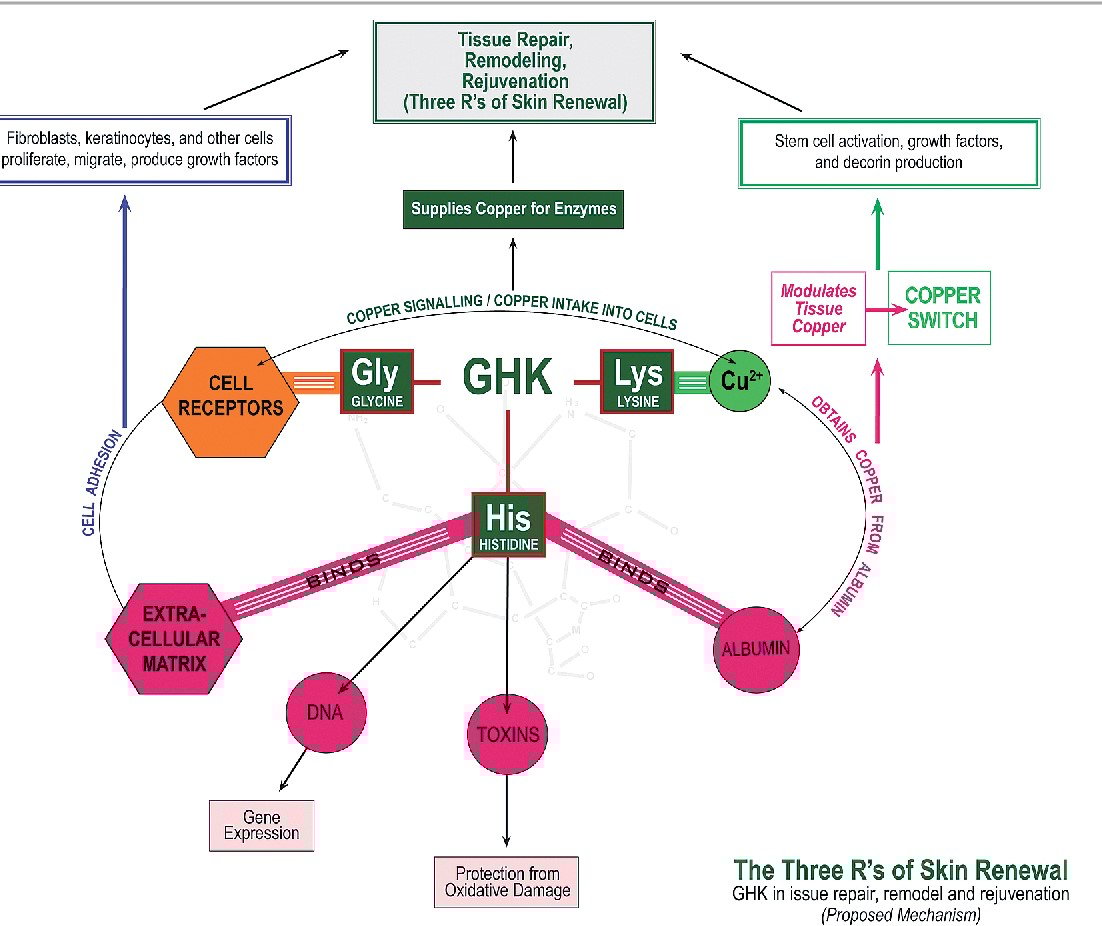
Source: Semantic Scholar
Preclinical Research Summary
Preclinical studies of GHK-Cu include in vitro experiments across fibroblast, endothelial, epithelial, and immune-relevant cell models, as well as in vivo animal studies in which injury-responsive endpoints are quantified. Reported findings commonly include changes in ECM-associated transcription/protein markers (e.g., collagen/elastin-related signals), modulation of inflammatory cytokine signaling (including pathways involving TNF-α and IL-6), and altered oxidative stress parameters consistent with engagement of antioxidant response pathways.
Additional animal-model literature describes changes in angiogenesis-associated signaling and remodeling markers in tissue injury paradigms. Separately, transcriptomic analyses described in the cited literature report that GHK-Cu exposure can shift expression of a substantial subset of measured genes in vitro, supporting its use as a laboratory tool for probing copper-linked transcriptional regulation and downstream pathway enrichment patterns. Research on metal-ion involvement in amyloidogenic protein chemistry has also examined GHK-Cu as a copper-sequestering variable in controlled aggregation and toxicity assay designs.
All summaries above refer only to controlled preclinical investigations and are provided to support experimental design considerations, mechanistic hypothesis generation, and pathway mapping in laboratory settings.
Form & Analytical Testing
GHK-Cu is supplied as a research-grade peptide–metal complex. Identity and composition are commonly assessed using analytical methods such as HPLC for purity profiling and mass spectrometry for molecular confirmation, with copper content/stoichiometry evaluated where applicable using techniques such as ICP-MS/ICP-OES or other validated elemental analysis approaches. UV-Vis or related spectroscopic methods may be used to characterize copper coordination features in solution under defined laboratory conditions.
Researchers should handle peptide–metal complexes using standard laboratory practices appropriate for synthetic peptides and transition-metal coordination compounds, including controls for metal contamination, chelator compatibility, and buffer composition effects on copper speciation during experimental setup.
Article Author
The above literature was researched, edited and organized by Dr. E. Logan, M.D. Dr. E. Logan holds a doctorate degree from Case Western Reserve University School of Medicine and a B.S. in molecular biology.
Scientific Journal Author
Loren Pickart, Ph.D. has released 109 publications and is developing patents and analyzing GHK’s effects on human gene expression of 4,192 genes. In addition to GHK’s published potential uses on skin inflammation, metastatic cancer and COPD, it appears to have beneficial effects on other tissue systems such as the nervous system, gastrointestinal system, and mitochondrial system. His brief but detailed autobiography dives into the motivations and background behind his dedicating to skin, anti-aging, and life-long training.
Loren Pickart, Ph.D is being referenced as one of the leading scientists involved in the research and development of GHK-Cu. In no way is this doctor/scientist endorsing or advocating the purchase, sale, or use of this product for any reason. There is no affiliation or relationship, implied or otherwise, between Peptide Sciences and this doctor. The purpose of citing the doctor is to acknowledge, recognize, and credit the exhaustive research and development efforts conducted by the scientists studying this peptide. Loren Pickart, Ph.D is listed in [3] [4] and [8] under the referenced citations.
Referenced Citations
- S. O. Canapp et al., “The effect of topical tripeptide-copper complex on healing of ischemic open wounds,” Vet. Surg. VS, vol. 32, no. 6, Art. no. 6, Dec. 2003, doi: 10.1111/j.1532-950x.2003.00515.x.
- Y. Dou, A. Lee, L. Zhu, J. Morton, and W. Ladiges, “The potential of GHK as an anti-aging peptide,” Aging Pathobiol. Ther., vol. 2, no. 1, pp. 58–61, Mar. 2020, doi: 10.31491/apt.2020.03.014.
- L. Pickart, “The human tri-peptide GHK and tissue remodeling,” J. Biomater. Sci. Polym. Ed., vol. 19, no. 8, pp. 969–988, 2008, doi: 10.1163/156856208784909435.
- L. Pickart and A. Margolina, “Regenerative and Protective Actions of the GHK-Cu Peptide in the Light of the New Gene Data,” Int. J. Mol. Sci., vol. 19, no. 7, p. 1987, Jul. 2018, doi: 10.3390/ijms19071987.
- S. Montes, S. Rivera-Mancia, A. Diaz-Ruiz, L. Tristan-Lopez, and C. Rios, “Copper and Copper Proteins in Parkinson’s Disease,” Oxid. Med. Cell. Longev., vol. 2014, p. e147251, Jan. 2014, doi: 10.1155/2014/147251.
- H. Kozlowski, M. Luczkowski, M. Remelli, and D. Valensin, “Copper, zinc and iron in neurodegenerative diseases (Alzheimer’s, Parkinson’s and prion diseases),” Coord. Chem. Rev., vol. 256, no. 19, pp. 2129–2141, Oct. 2012, doi: 10.1016/j.ccr.2012.03.013.
- K. Rajasekhar, C. Madhu, and T. Govindaraju, “Natural Tripeptide-Based Inhibitor of Multifaceted Amyloid β Toxicity,” ACS Chem. Neurosci., vol. 7, no. 9, pp. 1300–1310, Sep. 2016, doi: 10.1021/acschemneuro.6b00175.
- L. Pickart, J. M. Vasquez-Soltero, and A. Margolina, “GHK and DNA: Resetting the Human Genome to Health,” BioMed Res. Int., vol. 2014, p. 151479, 2014, doi: 10.1155/2014/151479.
- Y. Wu, K. Cao, W. Zhang, G. Zhang, and M. Zhou, “Protective and Anti-Aging Effects of 5 Cosmeceutical Peptide Mixtures on Hydrogen Peroxide-Induced Premature Senescence in Human Skin Fibroblasts,” Skin Pharmacol. Physiol., vol. 34, no. 4, pp. 194–202, 2021, doi: 10.1159/000514496.
- X. Yang, Y. Zhang, C. Huang, L. Lu, J. Chen, and Y. Weng, “Biomimetic Hydrogel Scaffolds with Copper Peptide-Functionalized RADA16 Nanofiber Improve Wound Healing in Diabetes,” Macromol. Biosci., vol. 22, no. 8, p. e2200019, Aug. 2022, doi: 10.1002/mabi.202200019.
- X. Wang et al., “GHK-Cu-liposomes accelerate scald wound healing in mice by promoting cell proliferation and angiogenesis,” Wound Repair Regen. Off. Publ. Wound Heal. Soc. Eur. Tissue Repair Soc., vol. 25, no. 2, pp. 270–278, Apr. 2017, doi: 10.1111/wrr.12520.
- Q. Zhang, L. Yan, J. Lu, and X. Zhou, “Glycyl-L-histidyl-L-lysine-Cu2 attenuates cigarette smoke-induced pulmonary emphysema and inflammation by reducing oxidative stress pathway,” Front. Mol. Biosci., vol. 9, p. 925700, 2022, doi: 10.3389/fmolb.2022.925700.
- J.-R. Park, H. Lee, S.-I. Kim, and S.-R. Yang, “The tri-peptide GHK-Cu complex ameliorates lipopolysaccharide-induced acute lung injury in mice,” Oncotarget, vol. 7, no. 36, pp. 58405–58417, Sep. 2016, doi: 10.18632/oncotarget.11168.
- M. Kukowska, M. Kukowska-Kaszuba, and K. Dzierzbicka, “In vitro studies of antimicrobial activity of Gly-His-Lys conjugates as potential and promising candidates for therapeutics in skin and tissue infections,” Bioorg. Med. Chem. Lett., vol. 25, no. 3, pp. 542–546, Feb. 2015, doi: 10.1016/j.bmcl.2014.12.029.
- W. Shen and T. Matsui, “Intestinal absorption of small peptides: a review,” Int. J. Food Sci. Technol., vol. 54, no. 6, pp. 1942–1948, 2019, doi: 10.1111/ijfs.14048.
ALL ARTICLES AND PRODUCT INFORMATION PROVIDED ON THIS WEBSITE ARE FOR INFORMATIONAL AND EDUCATIONAL PURPOSES ONLY.
RUO Disclaimer
The products offered on this website are furnished for in-vitro studies only. In-vitro studies (Latin: in glass) are performed outside of the body. These products are not medicines or drugs and have not been approved by the FDA to prevent, treat or cure any medical condition, ailment or disease. Bodily introduction of any kind into humans or animals is strictly forbidden by law.
For Laboratory Research Only. Not for human use, medical use, diagnostic use, or veterinary use.
Why Choose Our GHK-Cu (2mg x 60 Capsules) (Copper Tripeptide)?
When you are looking for GHK-Cu (2mg x 60 Capsules) (Copper Tripeptide) for sale, quality is paramount.
Our products undergo rigorous testing to ensure they meet the strict requirements of laboratory environments.
By choosing to buy GHK-Cu (2mg x 60 Capsules) (Copper Tripeptide) from our store, you are guaranteed a product that is:
- High Purity (Tested for 99%+)
- Fast Shipping – Always in stock
- Secure Packaging for Research Integrity
- Competitive Pricing for Bulk Orders
Specifications & Technical Data
| Feature | Specification |
|---|---|
| Product Name | GHK-Cu (2mg x 60 Capsules) (Copper Tripeptide) |
| SKU | 42 |
| Purity | >99% |
| Form | Research Grade Compound |
| Availability | In Stock / For Sale |
Scientific Research & Clinical Applications
The research surrounding GHK-Cu (2mg x 60 Capsules) (Copper Tripeptide) is vast. Scientists explore its potential in various metabolic and physiological models.
For more detailed scientific data, you can visit PubMed
to review the latest peer-reviewed literature regarding this compound.
Frequently Asked Questions
Where can I buy GHK-Cu (2mg x 60 Capsules) (Copper Tripeptide)?
You can buy GHK-Cu (2mg x 60 Capsules) (Copper Tripeptide) directly from our website. We provide a secure checkout and fast shipping to ensure your research stays on track.
Is GHK-Cu (2mg x 60 Capsules) (Copper Tripeptide) in stock?
Yes, we currently have GHK-Cu (2mg x 60 Capsules) (Copper Tripeptide) in stock. Orders are typically processed within 24 hours to ensure rapid delivery to your laboratory.
Related Research Products
If you are interested in GHK-Cu (2mg x 60 Capsules) (Copper Tripeptide), you may also want to explore these related products currently in stock:
Disclaimer: All products listed are for research purposes only. Not for human consumption.
Related products
All Peptides

All Peptides

All Peptides

All Peptides

All Peptides

All Peptides

All Peptides
All Peptides