

AICAR 50mg


$65.00
AICAR is a research compound (5-Aminoimidazole-4-carboxamide ribonucleotide) that acts as an AMP analog activating AMP-activated protein kinase (AMPK). Preclinical models show its effects on mitochondrial biogenesis, fatty acid oxidation, and glucose metabolism through AMPK–PGC-1α signaling. AICAR is used in metabolic and energy regulation research investigating peptide-independent AMPK activation pathways.
For research use only. Not for human consumption.
References:
Corton JM et al., Eur J Biochem, 1995 229(2):558–565
Hardie DG et al., Nat Rev Mol Cell Biol, 2012 13(4):251–262
Winder WW et al., Am J Physiol, 2000 279(5):E1106–E1112
AICAR 50mg – Buy High-Quality AICAR 50mg Online
Looking to buy AICAR 50mg for your research laboratory? You have come to the right place.
We currently have AICAR 50mg for sale and it is in stock and ready for immediate shipping.
Our AICAR 50mg is of the highest purity, making it the best AICAR 50mg online for scientific studies.
Product Overview
AICAR 50mg is a premium research compound widely utilized in various scientific studies.
Researchers seeking to buy AICAR 50mg online often prioritize purity and consistency.
This compound has been studied extensively for its unique biochemical properties and its role in cellular pathways.
Overview: AICAR (5-Aminoimidazole-4-carboxamide Ribonucleoside)
AICAR (5-aminoimidazole-4-carboxamide ribonucleoside) is a small-molecule research reagent used to interrogate cellular energy-sensing and metabolic signaling networks. In laboratory systems, AICAR is employed as a tool compound to activate AMP-activated protein kinase (AMPK) and to profile downstream changes in substrate utilization, stress-response signaling, transcriptional programs, and cell-cycle regulation in cell culture and in vivo animal models.
AICAR is frequently used in experimental workflows that quantify AMPK-associated effects on glucose transport, inflammatory pathway outputs, and proliferation/survival endpoints under controlled conditions. All descriptions are provided for mechanistic and preclinical research context only.
Biochemical Characteristics
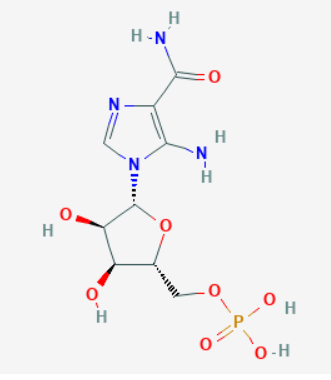
Source: PubChem
Sequence: 5-aminoimidazole-4-carboxamide ribonucleoside
Molecular Formula: C9H15N4O8P
Molecular Weight: 338.213 g/mol
PubChem CID: 65110
CAS Number: 3031-94-5
Synonyms: AICA ribonucletotide, Z-nucleotide
Research Applications
- AMPK activation assays for pathway mapping, phosphorylation-state profiling, and metabolic flux experiments.
- Glucose transport research in muscle models, including insulin-stimulated uptake and GLUT-4 content/trafficking endpoints.
- Inflammation and immune-signaling studies evaluating AMPK-linked modulation of macrophage signaling and cytokine outputs.
- Cell-cycle and apoptosis research assessing AMPK-associated p38 MAPK signaling, p21-related checkpoints, and caspase-linked pathways.
- Vascular biology experiments evaluating smooth muscle proliferation and leukocyte rolling/adhesion mechanisms in preclinical models.
- Reproductive biology tool studies evaluating AMPK-linked regulation of spermatozoa energy metabolism and motility endpoints in species-specific systems.
Pathway / Mechanistic Context
Core target node: AMPK functions as a central integrator of cellular energy status, coordinating metabolic adaptation through downstream regulation of substrate transport, mitochondrial activity, and transcriptional responses to energetic stress.
Metabolic signaling interface: In preclinical muscle models, AMPK activation has been evaluated alongside insulin-linked signaling readouts and GLUT-4-associated endpoints to characterize glucose uptake regulation under defined experimental conditions.
Inflammation-associated signaling: AMPK activation is commonly explored for effects on NF-κB-associated transcriptional programs and macrophage inflammatory outputs, supporting mechanistic studies in adipose- and colitis-related models.
Stress-response and cell fate pathways: In cultured cells, AMPK activation can intersect with p38 MAPK signaling and p21 accumulation, and may engage caspase-linked apoptosis machinery depending on model context and experimental design.
Vascular remodeling: AMPK-linked cell-cycle regulation has been studied in vascular smooth muscle proliferation models, and preconditioning paradigms have been used to evaluate leukocyte rolling/adhesion endpoints in microcirculation research.
Preclinical Research Summary
In mouse models, AICAR has been used as an AMPK-activating tool compound to evaluate adipose inflammatory signaling and insulin resistance-associated endpoints, including studies describing dependence on myeloid SIRT1 in specific experimental settings[1]. Additional preclinical work reports AMPK activation effects on inflammatory response markers and metabolic disorder phenotypes in particulate exposure models[2].
In rat skeletal muscle models, AICAR has been used to compare exercise-linked signaling to AMPK activation, including insulin-stimulated glucose uptake and GLUT-4 content endpoints[3]. In cell culture and animal models, AICAR-mediated AMPK activation has been evaluated in proliferation and survival assays in multiple cell lines, including studies reporting AMPK-associated growth control and stress susceptibility effects[4], [5].
In inflammation-focused models, AICAR has been used to assess immune signaling mechanisms (including NF-κB-associated macrophage signaling and TH1/TH17-type cytokine outputs) in preclinical colitis paradigms[9]. In vascular biology, AMPK activation has been evaluated for effects on vascular smooth muscle proliferation via cell-cycle regulation[10], and microcirculation models have been used to study leukocyte rolling/adhesion endpoints in AICAR-associated preconditioning experiments[14].
In reproductive biology tool studies, AMPK activators including AICAR have been used in species-specific systems to evaluate spermatozoa energy metabolism and motility endpoints[12], [13].
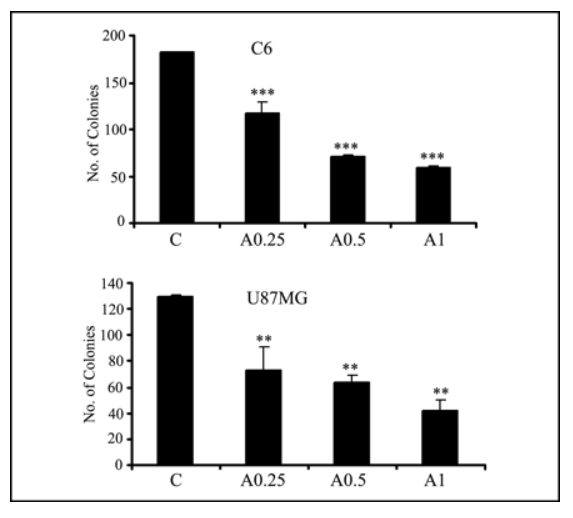
AICAR inhibits clonal growth of glioma (C6) and prostate cells.
Source: Journal of Biological Chemistry
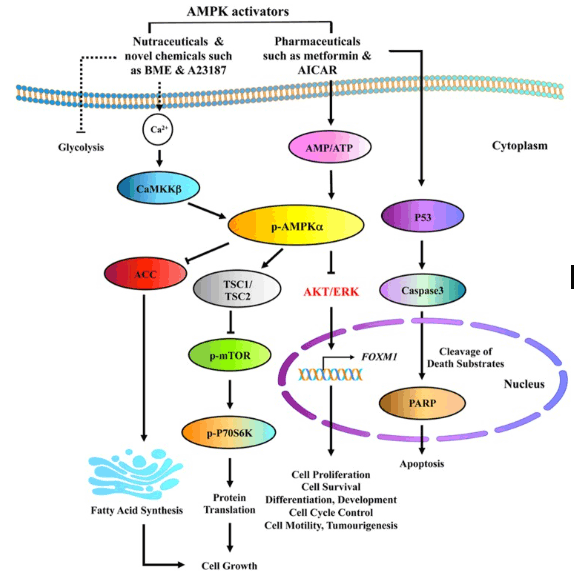
AMPK activators, like AICAR, influence a number of pathways that can impact cancer growth.
Source: PubMed
Form & Analytical Testing
AICAR is supplied as a research reagent for laboratory experimentation. Product identity and purity are commonly verified using standard analytical techniques such as HPLC and mass spectrometry (MS). Researchers should select solvent systems and storage conditions appropriate for nucleoside analogs and for compatibility with the intended in vitro or in vivo protocol.
Referenced Citations
- Z. Yang et al., “The full capacity of AICAR to reduce obesity-induced inflammation and insulin resistance requires myeloid SIRT1,” PloS One, vol. 7, no. 11, p. e49935, 2012.
- K. Pan et al., “AMPK activation attenuates inflammatory response to reduce ambient PM2.5-induced metabolic disorders in healthy and diabetic mice,” Ecotoxicol. Environ. Saf., vol. 179, pp. 290–300, Sep. 2019.
- N. Jessen, R. Pold, E. S. Buhl, L. S. Jensen, O. Schmitz, and S. Lund, “Effects of AICAR and exercise on insulin-stimulated glucose uptake, signaling, and GLUT-4 content in rat muscles,” J. Appl. Physiol. Bethesda Md 1985, vol. 94, no. 4, pp. 1373–1379, Apr. 2003.
- J. Zhuge, “Overexpression of CYP2E1 induces HepG2 cells death by the AMP kinase activator 5’-aminoimidazole-4-carboxamide-1-beta-D-ribofuranoside (AICAR),” Cell Biol. Toxicol., vol. 25, no. 3, pp. 253–263, Jun. 2009.
- R. Rattan, S. Giri, A. K. Singh, and I. Singh, “5-Aminoimidazole-4-carboxamide-1-beta-D-ribofuranoside inhibits cancer cell proliferation in vitro and in vivo via AMP-activated protein kinase,” J. Biol. Chem., vol. 280, no. 47, pp. 39582–39593, Nov. 2005.
- M. M. H. Yung, H. Y. S. Ngan, and D. W. Chan, “Targeting AMPK signaling in combating ovarian cancers: opportunities and challenges,” Acta Biochim. Biophys. Sin., vol. 48, no. 4, pp. 301–317, Apr. 2016.
- W. G. Kim, H.-J. Choi, T. Y. Kim, Y. K. Shong, and W. B. Kim, “The effect of 5-aminoimidazole-4-carboxamide-ribonucleoside was mediated by p38 mitogen activated protein kinase signaling pathway in FRO thyroid cancer cells,” Korean J. Intern. Med., vol. 29, no. 4, pp. 474–481, Jul. 2014.
- X.-W. Peng, H.-H. Zhou, J. Dai, and L. Zhang, “[Advances on the anti-inflammatory and protective effect of AMPK activators],” Sheng Li Xue Bao, vol. 71, no. 2, pp. 319–326, Apr. 2019.
- A. Bai et al., “Novel anti-inflammatory action of 5-aminoimidazole-4-carboxamide ribonucleoside with protective effect in dextran sulfate sodium-induced acute and chronic colitis,” J. Pharmacol. Exp. Ther., vol. 333, no. 3, pp. 717–725, Jun. 2010.
- M. Igata et al., “Adenosine monophosphate-activated protein kinase suppresses vascular smooth muscle cell proliferation through the inhibition of cell cycle progression,” Circ. Res., vol. 97, no. 8, pp. 837–844, Oct. 2005.
- M. Sakai, S. Kobori, A. Miyazaki, and S. Horiuchi, “Macrophage proliferation in atherosclerosis,” Curr. Opin. Lipidol., vol. 11, no. 5, pp. 503–509, Oct. 2000.
- P. Thuwanut, P. Comizzoli, K. Pruksananonda, K. Chatdarong, and N. Songsasen, “Activation of adenosine monophosphate-activated protein kinase (AMPK) enhances energy metabolism, motility, and fertilizing ability of cryopreserved spermatozoa in domestic cat model,” J. Assist. Reprod. Genet., May 2019.
- Z. Zhu et al., “5’-AMP-Activated Protein Kinase Regulates Goat Sperm Functions via Energy Metabolism In Vitro,” Cell. Physiol. Biochem. Int. J. Exp. Cell. Physiol. Biochem. Pharmacol., vol. 47, no. 6, pp. 2420–2431, 2018.
- F. Spencer Gaskin, Kazuhiro Kamada, Mozow Yusof, William Durante, Garrett Gross & Ronald J. Korthuis (2009) AICAR Preconditioning Prevents Postischemic Leukocyte Rolling and Adhesion: Role of KATP Channels and Heme Oxygenase, Microcirculation, 16:2, 167-176, DOI: 10.1080/10739680802355897
ALL ARTICLES AND PRODUCT INFORMATION PROVIDED ON THIS WEBSITE ARE FOR INFORMATONAL AND EDUCATIONAL PURPOSES ONLY.
RUO Disclaimer
The products offered on this website are furnished for in-vitro studies only. In-vitro studies (Latin: in glass) are performed outside of the body. These products are not medicines or drugs and have not been approved by the FDA to prevent, treat or cure any medical condition, ailment or disease. Bodily introduction of any kind into humans or animals is strictly forbidden by law.
For Laboratory Research Only. Not for human use, medical use, diagnostic use, or veterinary use.
Storage Instructions:
All of our products are manufactured using the Lyophilization (Freeze Drying) process, which ensures that our products remain 100% stable for shipping for up to 3-4 months.
Once the peptides are reconstituted (mixed with bacteriostatic water), they must be stored in the fridge to maintain stability. After reconstitution, the peptides will remain stable for up to 30 days.
Lyophilization is a unique dehydration process, also known as cryodesiccation, where the peptides are frozen and then subjected to low pressure. This causes the water in the peptide vial to sublimate directly from solid to gas, leaving behind a stable, crystalline white structure known as lyophilized peptide. The puffy white powder can be stored at room temperature until you’re ready to reconstitute it with bacteriostatic water.
Once peptides have been received, it is imperative that they are kept cold and away from light. If the peptides will be used immediately, or in the next several days, weeks or months, short-term refrigeration under 4C (39F) is generally acceptable. Lyophilized peptides are usually stable at room temperatures for several weeks or more, so if they will be utilized within weeks or months such storage is typically adequate.
However, for longer term storage (several months to years) it is more preferable to store peptides in a freezer at -80C (-112F). When storing peptides for months or even years, freezing is optimal in order to preserve the peptide’s stability.
Why Choose Our AICAR 50mg?
When you are looking for AICAR 50mg for sale, quality is paramount.
Our products undergo rigorous testing to ensure they meet the strict requirements of laboratory environments.
By choosing to buy AICAR 50mg from our store, you are guaranteed a product that is:
- High Purity (Tested for 99%+)
- Fast Shipping – Always in stock
- Secure Packaging for Research Integrity
- Competitive Pricing for Bulk Orders
Specifications & Technical Data
| Feature | Specification |
|---|---|
| Product Name | AICAR 50mg |
| SKU | 6 |
| Purity | >99% |
| Form | Research Grade Compound |
| Availability | In Stock / For Sale |
Scientific Research & Clinical Applications
The research surrounding AICAR 50mg is vast. Scientists explore its potential in various metabolic and physiological models.
For more detailed scientific data, you can visit PubMed
to review the latest peer-reviewed literature regarding this compound.
Frequently Asked Questions
Where can I buy AICAR 50mg?
You can buy AICAR 50mg directly from our website. We provide a secure checkout and fast shipping to ensure your research stays on track.
Is AICAR 50mg in stock?
Yes, we currently have AICAR 50mg in stock. Orders are typically processed within 24 hours to ensure rapid delivery to your laboratory.
Related Research Products
If you are interested in AICAR 50mg, you may also want to explore these related products currently in stock:
- Ipamorelin 2mg
- Gut Inflammation (60 Capsules) (Stable BPC-157 Arginate, KPV, Larazotide)
- PT-141 (3mg x 10 Vials = 30mg)
Disclaimer: All products listed are for research purposes only. Not for human consumption.
Related products

All Peptides
All Peptides

All Peptides
All Peptides

All Peptides
All Peptides

All Peptides

All Peptides