
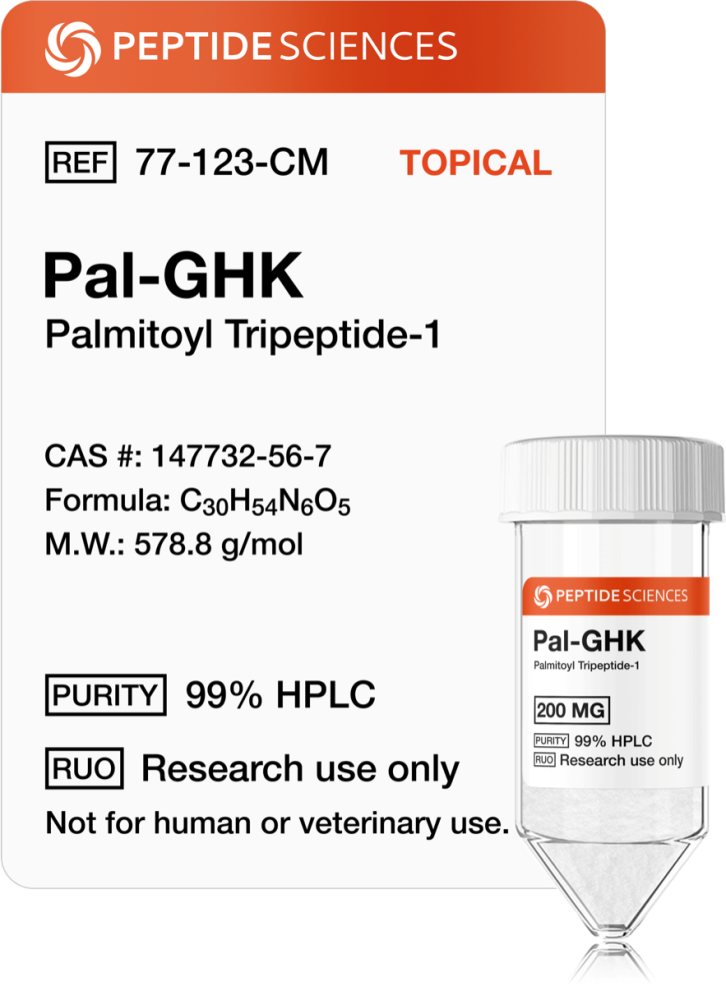
Pal-GHK 200mg (Palmitoyl Tripeptide-1) (Topical)
$210.00
Pal-GHK (Palmitoyl Tripeptide-1) is a research peptide formed by conjugating Gly-His-Lys to palmitic acid to enhance dermal delivery. It modulates extracellular matrix synthesis and gene expression related to fibroblast proliferation and collagen metabolism. Pal-GHK is used in preclinical research exploring peptide-induced dermal repair, ECM remodeling, and cell–matrix communication.
For research use only. Not for human consumption.
References:
Maquart FX et al., FEBS Lett, 1988 238(2):343–346
Katayama K et al., J Biochem, 2010 147(1):61–69
Siméon A et al., J Invest Dermatol, 2000 115(6):961–968
Pal-GHK 200mg (Palmitoyl Tripeptide-1) (Topical) – Buy High-Quality Pal-GHK 200mg (Palmitoyl Tripeptide-1) (Topical) Online
Looking to buy Pal-GHK 200mg (Palmitoyl Tripeptide-1) (Topical) for your research laboratory? You have come to the right place.
We currently have Pal-GHK 200mg (Palmitoyl Tripeptide-1) (Topical) for sale and it is in stock and ready for immediate shipping.
Our Pal-GHK 200mg (Palmitoyl Tripeptide-1) (Topical) is of the highest purity, making it the best Pal-GHK 200mg (Palmitoyl Tripeptide-1) (Topical) online for scientific studies.
Product Overview
Pal-GHK 200mg (Palmitoyl Tripeptide-1) (Topical) is a premium research compound widely utilized in various scientific studies.
Researchers seeking to buy Pal-GHK 200mg (Palmitoyl Tripeptide-1) (Topical) online often prioritize purity and consistency.
This compound has been studied extensively for its unique biochemical properties and its role in cellular pathways.
Overview: Pal-GHK 200mg (Palmitoyl Tripeptide-1)
Pal-GHK (also referred to as Palmitoyl Tripeptide-1 or palmitoyl oligopeptide) is a synthetic lipopeptide consisting of the tripeptide sequence Gly-His-Lys (GHK) conjugated to a palmitoyl fatty acid. In laboratory research, Pal-GHK is used as a tool compound to investigate peptide–lipid conjugation effects on cellular uptake, fibroblast-associated signaling, and extracellular matrix (ECM) regulation in preclinical experimental systems.
Biochemical Characteristics
Sequence (Three-Letter Code): Palmitoyl-Gly-His-Lys
Molecular formula:C30H54N6O5
Molecular weight: 578.8 g/mol
Pal-GHK is a peptide–lipid conjugate in which a palmitoyl chain increases hydrophobic character relative to the parent tripeptide. This modification is commonly used in preclinical research to evaluate how lipidation alters peptide partitioning into membranes, transport across biological barriers in model systems, and intracellular availability in cultured cells.
Research Applications
-
Fibroblast / ECM studies: Investigation of fibroblast-associated ECM gene programs, including collagen- and elastin-related expression in cell culture and animal models.
-
Peptide lipidation research: Comparative studies of peptide vs. lipopeptide behavior to evaluate the impact of palmitoylation on membrane affinity and cellular uptake.
-
Signal transduction mapping: Profiling of peptide-driven changes in growth-factor and cytokine signaling networks relevant to connective tissue biology under controlled experimental conditions.
-
Combination-design experiments: Use in multi-peptide research designs to assess additive or interaction effects on mechanistic readouts in vitro or in vivo models [1].
Pathway / Mechanistic Context
Fibroblasts are primary producers of extracellular matrix components and are frequently used in preclinical models to study connective-tissue homeostasis, ECM turnover, and matrix-associated signaling. Short peptide motifs derived from matrix proteins (or matrix-associated fragments) are commonly evaluated as mechanistic probes for fibroblast activation states and downstream transcriptional responses.
The GHK tripeptide motif has been studied in vitro and in vivo for its capacity to influence fibroblast behavior and redox-associated gene expression in preclinical systems [2]. Lipidation with palmitoyl is used experimentally to modulate physicochemical properties (e.g., hydrophobicity and membrane interaction), enabling structure–activity work on peptide delivery and intracellular engagement in model systems.
Preclinical Research Summary
Preclinical literature describing palmitoylated tripeptides and related GHK-based systems has evaluated changes in ECM-associated readouts, including collagen- and elastin-linked expression patterns, using experimental skin-relevant models and cell culture platforms [2]. In these contexts, Pal-GHK is frequently discussed as part of broader ingredient systems and multi-component research formulations [1].
Published work on over-the-counter topical agent evaluation and erythema/photoaging management includes clinical framing; however, within an RUO context, these reports may be used strictly as background references for mechanistic hypotheses, assay design, and selection of laboratory endpoints (e.g., ECM markers, inflammatory mediators, oxidative-stress gene panels) rather than as evidence of outcomes in any intended-use setting [3–5].
Form & Analytical Testing
Pal-GHK (Palmitoyl Tripeptide-1) is supplied as a purified research reagent intended for laboratory experimentation. Product identity and purity are typically confirmed using analytical techniques such as high-performance liquid chromatography (HPLC) and mass spectrometry (MS). Standard peptide handling and storage practices should be followed in research environments.
Referenced Citations
- Goldsberry, S. & Garcines, L. Anti-aging cosmeceutical composition. (2013).
- Pickart, L., Vasquez-Soltero, J. M. & Margolina, A. GHK-Cu may Prevent Oxidative Stress in Skin by Regulating Copper and Modifying Expression of Numerous Antioxidant Genes. Cosmetics 2, 236–247 (2015).
- Trookman, N. S., Rizer, R. L., Ford, R., Mehta, R. & Gotz, V. Clinical assessment of a combination lip treatment to restore moisturization and fullness. J. Clin. Aesthetic Dermatol. 2, 44–48 (2009).
- Dupont, E. et al. Clinical efficacy of a serum integrating multiple cosmetic ingredients in the management of erythema of the face in aging skin. J. Cosmet. Dermatol. 11, 207–212 (2012).
- Bradley, E. J., Griffiths, C. E. M., Sherratt, M. J., Bell, M. & Watson, R. E. B. Over-the-counter anti-ageing topical agents and their ability to protect and repair photoaged skin. Maturitas 80, 265–272 (2015).
ALL ARTICLES AND PRODUCT INFORMATION PROVIDED ON THIS WEBSITE ARE FOR INFORMATIONAL AND EDUCATIONAL PURPOSES ONLY.
RUO Disclaimer
The products offered on this website are furnished for in-vitro studies only. In-vitro studies (Latin: in glass) are performed outside of the body. These products are not medicines or drugs and have not been approved by the FDA to prevent, treat or cure any medical condition, ailment or disease. Bodily introduction of any kind into humans or animals is strictly forbidden by law.
For Laboratory Research Only. Not for human use, medical use, diagnostic use, or veterinary use.
Why Choose Our Pal-GHK 200mg (Palmitoyl Tripeptide-1) (Topical)?
When you are looking for Pal-GHK 200mg (Palmitoyl Tripeptide-1) (Topical) for sale, quality is paramount.
Our products undergo rigorous testing to ensure they meet the strict requirements of laboratory environments.
By choosing to buy Pal-GHK 200mg (Palmitoyl Tripeptide-1) (Topical) from our store, you are guaranteed a product that is:
- High Purity (Tested for 99%+)
- Fast Shipping – Always in stock
- Secure Packaging for Research Integrity
- Competitive Pricing for Bulk Orders
Specifications & Technical Data
| Feature | Specification |
|---|---|
| Product Name | Pal-GHK 200mg (Palmitoyl Tripeptide-1) (Topical) |
| SKU | 104 |
| Purity | >99% |
| Form | Research Grade Compound |
| Availability | In Stock / For Sale |
Scientific Research & Clinical Applications
The research surrounding Pal-GHK 200mg (Palmitoyl Tripeptide-1) (Topical) is vast. Scientists explore its potential in various metabolic and physiological models.
For more detailed scientific data, you can visit PubMed
to review the latest peer-reviewed literature regarding this compound.
Frequently Asked Questions
Where can I buy Pal-GHK 200mg (Palmitoyl Tripeptide-1) (Topical)?
You can buy Pal-GHK 200mg (Palmitoyl Tripeptide-1) (Topical) directly from our website. We provide a secure checkout and fast shipping to ensure your research stays on track.
Is Pal-GHK 200mg (Palmitoyl Tripeptide-1) (Topical) in stock?
Yes, we currently have Pal-GHK 200mg (Palmitoyl Tripeptide-1) (Topical) in stock. Orders are typically processed within 24 hours to ensure rapid delivery to your laboratory.
Related Research Products
If you are interested in Pal-GHK 200mg (Palmitoyl Tripeptide-1) (Topical), you may also want to explore these related products currently in stock:
Disclaimer: All products listed are for research purposes only. Not for human consumption.
Related products
All Peptides

All Peptides
All Peptides

All Peptides

All Peptides

All Peptides

All Peptides
All Peptides