
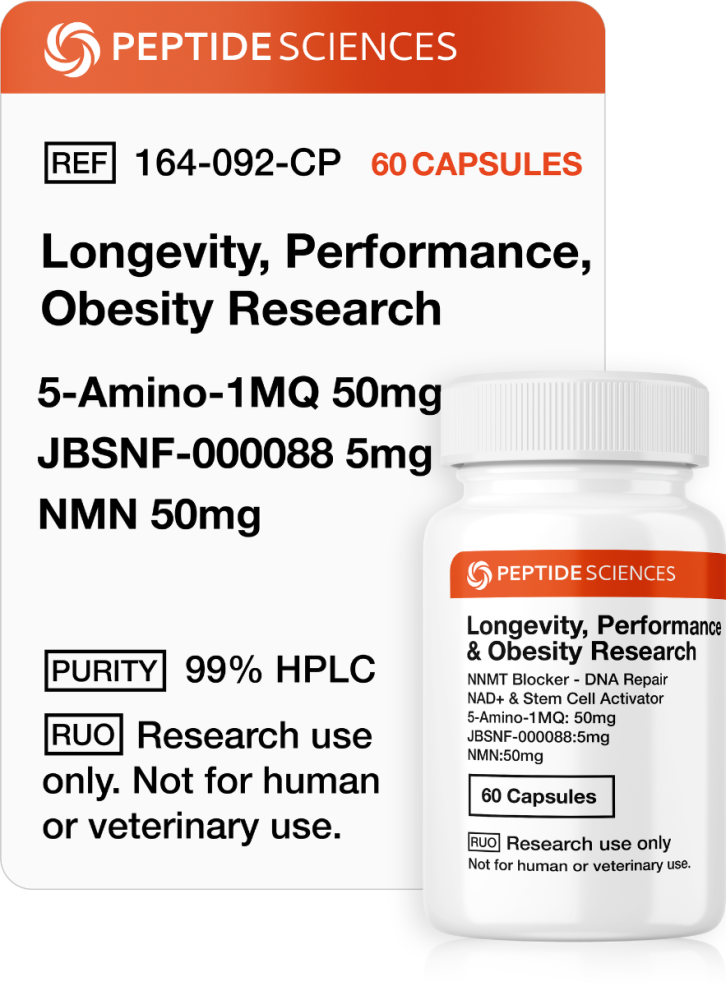
Longevity, Performance & Obesity Research (60 Capsules)
$300.00
Longevity, Performance & Obesity Research is a research peptide formulation developed to investigate metabolic regulation, mitochondrial function, and nutrient-sensing pathways. Preclinical studies indicate that its components modulate AMPK activation, sirtuin signaling, and oxidative stress response, supporting models of cellular energy balance and redox regulation. This formulation is utilized in experimental research focused on longevity signaling, performance metabolism, and molecular mechanisms of energy efficiency.
References:
Cantó C et al., Cell Metab, 2015 22(3):504–517
Lopez-Otin C et al., Cell, 2016 166(4):802–821
Verdin E et al., Science, 2015 350(6265):1208–1213
These capsules are provided exclusively as inert containers for the dry transport, storage, and handling of laboratory research materials. They are not dosage forms and are not intended for ingestion or administration. They must not be used as drug delivery systems, consumed, or administered in any form. For Research Use Only: Not for use in humans or animals. Not for diagnostic or therapeutic purposes.
Longevity, Performance & Obesity Research (60 Capsules) – Buy High-Quality Longevity, Performance & Obesity Research (60 Capsules) Online
Looking to buy Longevity, Performance & Obesity Research (60 Capsules) for your research laboratory? You have come to the right place.
We currently have Longevity, Performance & Obesity Research (60 Capsules) for sale and it is in stock and ready for immediate shipping.
Our Longevity, Performance & Obesity Research (60 Capsules) is of the highest purity, making it the best Longevity, Performance & Obesity Research (60 Capsules) online for scientific studies.
Product Overview
Longevity, Performance & Obesity Research (60 Capsules) is a premium research compound widely utilized in various scientific studies.
Researchers seeking to buy Longevity, Performance & Obesity Research (60 Capsules) online often prioritize purity and consistency.
This compound has been studied extensively for its unique biochemical properties and its role in cellular pathways.
Overview
This product page provides a laboratory-focused overview of three research-use compounds frequently evaluated in preclinical studies of nicotinamide metabolism and methylation-dependent metabolic regulation: Nicotinamide Mononucleotide (NMN), 5-Amino-1MQ (a small-molecule NNMT inhibitor class representative), and JBSNF-000088 (6-methoxynicotinamide).
In experimental systems, these compounds are used as biochemical tools to investigate NAD salvage dynamics, nicotinamide N-methyltransferase (NNMT) enzymatic activity, methyl-donor utilization, and downstream molecular readouts related to energy substrate handling, transcriptional regulation, and metabolite partitioning. All discussions herein are restricted to in-vitro, ex-vivo, or in-vivo animal research contexts.
Biochemical Characteristics
Nicotinamide Mononucleotide (NMN): NMN is a phosphorylated nicotinamide riboside intermediate within the NAD salvage pathway. In laboratory research, NMN is utilized to modulate intracellular NAD pools and to examine downstream effects on NAD-dependent enzymes such as sirtuins and poly(ADP-ribose) polymerases (PARPs).
5-Amino-1MQ: 5-Amino-1MQ is a membrane-permeable small-molecule compound reported in preclinical literature to inhibit NNMT enzymatic activity. NNMT catalyzes the methylation of nicotinamide using S-adenosyl-L-methionine (SAM), yielding 1-methylnicotinamide (MNA) and S-adenosyl-L-homocysteine (SAH).
JBSNF-000088 (6-Methoxynicotinamide): JBSNF-000088 is a nicotinamide analog studied in animal models for its influence on NNMT-associated metabolite profiles. Preclinical investigations often assess tissue-specific concentrations of MNA and related metabolites following exposure.
Research Applications
- Investigation of NAD salvage pathway flux and NAD-dependent enzyme activity
- NNMT inhibition studies including enzyme kinetics and target engagement assays
- Analysis of methyl-donor utilization (SAM/SAH ratios) and one-carbon metabolism
- Quantification of glucose transporter expression (e.g., GLUT4) in cellular and animal models
- Tissue-specific metabolomics profiling of nicotinamide-derived metabolites
Pathway / Mechanistic Context
NNMT occupies a regulatory position linking nicotinamide clearance with methyl-donor metabolism. By consuming SAM during nicotinamide methylation, NNMT activity influences intracellular methylation capacity, which is routinely evaluated in preclinical systems through metabolite ratios and transcriptional profiling.
NMN supplementation in experimental models is used to elevate NAD availability, thereby enabling mechanistic interrogation of NAD-dependent signaling pathways. These include redox reactions, post-translational protein modification, and DNA damage response signaling cascades.
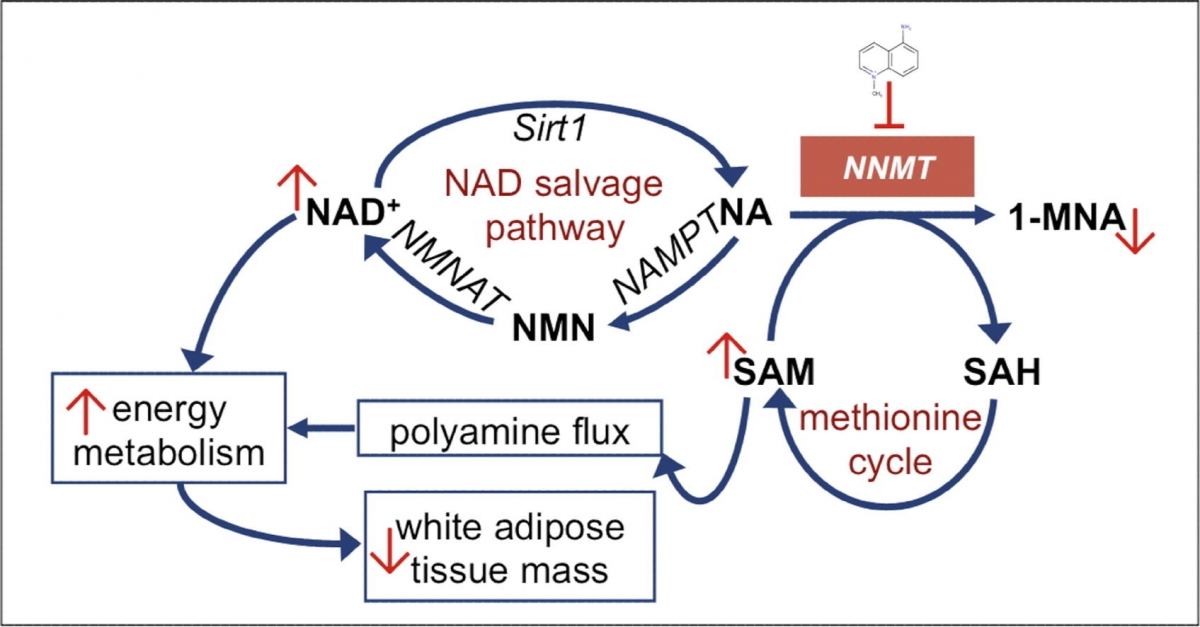
Source: NCBI
Preclinical Research Summary
Preclinical animal studies examining NNMT inhibition frequently report changes in adipose tissue morphology, metabolite distribution, and glucose handling metrics under controlled dietary conditions. These outcomes are evaluated using biochemical assays, histological analysis, and targeted gene expression profiling.
NMN-based studies in rodent models often quantify NAD pool size, mitochondrial enzyme activity, and transcriptional markers associated with metabolic adaptation. These measurements are used to map pathway-level responses to altered NAD availability.
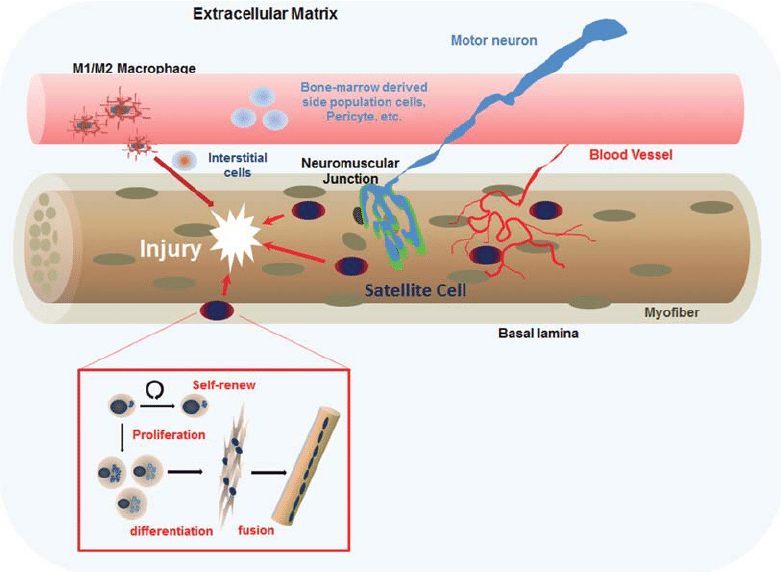
Cellular Turnover and Genome Maintenance (Preclinical Context)
Some experimental systems additionally assess cellular turnover, progenitor cell abundance, and DNA damage response signaling. These analyses focus on measurable endpoints such as cell cycle markers, lineage-specific transcription factors, and DNA repair pathway activation states, without reference to organism-level functional outcomes.
Source: ResearchGate
Form & Analytical Testing
Research-grade materials are typically characterized using analytical techniques including HPLC or UPLC for purity assessment, LC-MS for molecular weight confirmation, and NMR spectroscopy for structural verification. Certificates of Analysis (COA) may document purity, identity, and residual solvent content.
Article Author
The above literature was researched, edited and organized by Dr. E. Logan, M.D. Dr. E. Logan holds a doctorate degree from Case Western Reserve University School of Medicine and a B.S. in molecular biology.
Scientific Journal Author
Barbara B. Kahn is chief of the Division of Endocrinology, Diabetes, and Metabolism at Beth Israel Deaconess Medical Center (BIDMC) and the George Richards Minot Professor of Medicine at Harvard Medical School. She is an internationally recognized scientist in the area of obesity and type 2 diabetes, and her lab investigates the molecular mechanisms underlying these conditions, including the regulation of insulin action, food intake, and energy balance. Kahn received BA and MD degrees from Stanford University and an MS from the University of California at Berkeley. After completing internal medicine training at the UC Davis Medical Center, she began her career in molecular research at the National Institutes of Health. Kahn has received numerous awards including the Outstanding Scientific Achievement Award from the American Diabetes Association; the H. C. Jacobaeus Prize from the Novo Nordisk Foundation and the Karolinska Institutet; the Charles H. Best Lectureship and Award from the University of Toronto; and the Gerald D. Aurbach Award Lecture from the Endocrine Society. Kahn was elected to the Institute of Medicine of the National Academies and is a fellow of the American Association for the Advancement of Science.
Barbara B. Kahn is being referenced as one of the leading scientists involved in the research and development of NMN, 5-Amino-1MQ, and JBSNF-000088. In no way is this doctor/scientist endorsing or advocating the purchase, sale, or use of this product for any reason. There is no affiliation or relationship, implied or otherwise, between Peptide Sciences and this doctor. The purpose of citing the doctor is to acknowledge, recognize, and credit the exhaustive research and development efforts conducted by the scientists studying this peptide. Barbara B. Kahn is listed in [1] under the referenced citations.
Referenced Citations
- D. Kraus et al., “Nicotinamide N-methyltransferase knockdown protects against diet-induced obesity,” Nature, vol. 508, no. 7495, pp. 258–262, Apr. 2014, doi: 10.1038/nature13198.
- A. Sazci, M. D. Ozel, E. Ergul, and C. Aygun, “Association of Nicotinamide-N-Methyltransferase Gene rs694539 Variant with Patients with Nonalcoholic Steatohepatitis,” Genet. Test. Mol. Biomark., vol. 17, no. 11, pp. 849–853, Aug. 2013, doi: 10.1089/gtmb.2013.0309.
- X.-J. Zhu et al., “Physiological Study on Association between Nicotinamide N-Methyltransferase Gene Polymorphisms and Hyperlipidemia,” BioMed Res. Int., vol. 2016, p. 7521942, 2016, doi: 10.1155/2016/7521942.
- K. Okabe, K. Yaku, K. Tobe, and T. Nakagawa, “Implications of altered NAD metabolism in metabolic disorders,” J. Biomed. Sci., vol. 26, no. 1, p. 34, May 2019, doi: 10.1186/s12929-019-0527-8.
- H. Neelakantan et al., “Selective and membrane-permeable small molecule inhibitors of nicotinamide N-methyltransferase reverse high fat diet-induced obesity in mice,” Biochem. Pharmacol., vol. 147, pp. 141–152, Jan. 2018, doi: 10.1016/j.bcp.2017.11.007.
- A. Kannt et al., “A small molecule inhibitor of Nicotinamide N-methyltransferase for the treatment of metabolic disorders,” Sci. Rep., vol. 8, no. 1, p. 3660, 26 2018, doi: 10.1038/s41598-018-22081-7.
- K. F. Mills et al., “Long-Term Administration of Nicotinamide Mononucleotide Mitigates Age-Associated Physiological Decline in Mice,” Cell Metab., vol. 24, no. 6, pp. 795–806, 13 2016, doi: 10.1016/j.cmet.2016.09.013.
- I. a scraper, “Has Harvard’s David Sinclair Found the Fountain of Youth?,” Boston Magazine, Oct. 29, 2019. https://www.bostonmagazine.com/health/2019/10/29/david-sinclair/ (accessed Aug. 05, 2020).
- Y. C. Jang, M. Sinha, M. Cerletti, C. Dall’Osso, and A. J. Wagers, “Skeletal Muscle Stem Cells: Effects of Aging and Metabolism on Muscle Regenerative Function,” Cold Spring Harb. Symp. Quant. Biol., vol. 76, pp. 101–111, Jan. 2011, doi: 10.1101/sqb.2011.76.010652.
ALL ARTICLES AND PRODUCT INFORMATION PROVIDED ON THIS WEBSITE ARE FOR INFORMATONAL AND EDUCATIONAL PURPOSES ONLY.
RUO Disclaimer
The products offered on this website are furnished for in-vitro studies only. In-vitro studies (Latin: in glass) are performed outside of the body. These products are not medicines or drugs and have not been approved by the FDA to prevent, treat or cure any medical condition, ailment or disease. Bodily introduction of any kind into humans or animals is strictly forbidden by law.
For Laboratory Research Only. Not for human use, medical use, diagnostic use, or veterinary use.
Why Choose Our Longevity, Performance & Obesity Research (60 Capsules)?
When you are looking for Longevity, Performance & Obesity Research (60 Capsules) for sale, quality is paramount.
Our products undergo rigorous testing to ensure they meet the strict requirements of laboratory environments.
By choosing to buy Longevity, Performance & Obesity Research (60 Capsules) from our store, you are guaranteed a product that is:
- High Purity (Tested for 99%+)
- Fast Shipping – Always in stock
- Secure Packaging for Research Integrity
- Competitive Pricing for Bulk Orders
Specifications & Technical Data
| Feature | Specification |
|---|---|
| Product Name | Longevity, Performance & Obesity Research (60 Capsules) |
| SKU | 78 |
| Purity | >99% |
| Form | Research Grade Compound |
| Availability | In Stock / For Sale |
Scientific Research & Clinical Applications
The research surrounding Longevity, Performance & Obesity Research (60 Capsules) is vast. Scientists explore its potential in various metabolic and physiological models.
For more detailed scientific data, you can visit PubMed
to review the latest peer-reviewed literature regarding this compound.
Frequently Asked Questions
Where can I buy Longevity, Performance & Obesity Research (60 Capsules)?
You can buy Longevity, Performance & Obesity Research (60 Capsules) directly from our website. We provide a secure checkout and fast shipping to ensure your research stays on track.
Is Longevity, Performance & Obesity Research (60 Capsules) in stock?
Yes, we currently have Longevity, Performance & Obesity Research (60 Capsules) in stock. Orders are typically processed within 24 hours to ensure rapid delivery to your laboratory.
Related Research Products
If you are interested in Longevity, Performance & Obesity Research (60 Capsules), you may also want to explore these related products currently in stock:
Disclaimer: All products listed are for research purposes only. Not for human consumption.
Related products
All Peptides

All Peptides

All Peptides

All Peptides
All Peptides

All Peptides

All Peptides

All Peptides